
Commercial Refrigeration Services in Lacey, WA
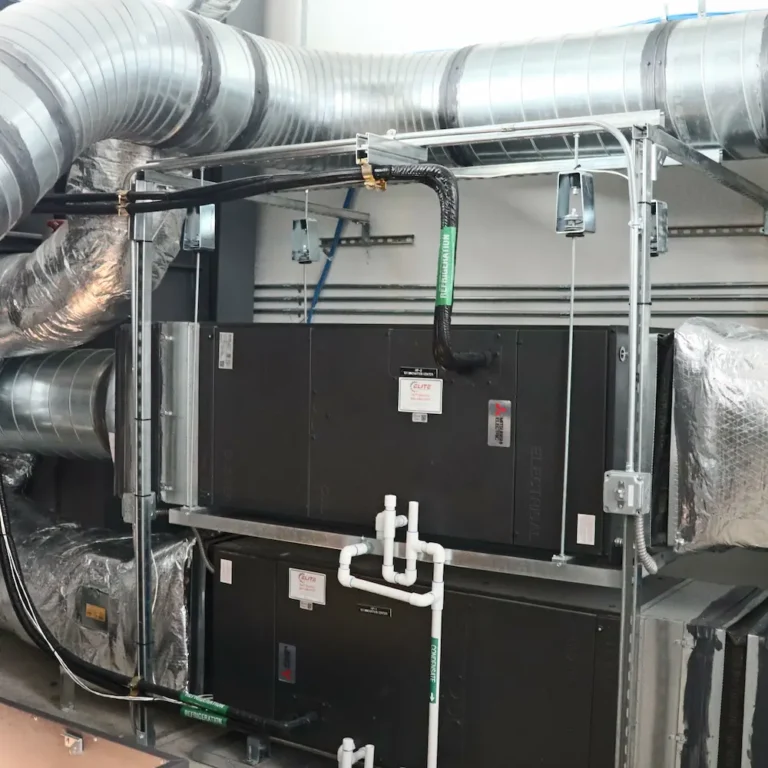
A commercial refrigeration failure is a different category of emergency from an HVAC breakdown. When a walk-in cooler loses temperature overnight, it’s not an uncomfortable building — it’s hundreds or thousands of dollars of perishable inventory at risk, a health department notification requirement if product safety is compromised, and a business interruption that starts the moment a kitchen manager opens the walk-in at 5 AM to find it at 55 degrees. The service clock on a refrigeration failure runs in hours, not days. Elite Mechanical Services provides commercial refrigeration repair, maintenance, and refrigerant service for walk-in coolers and freezers, reach-in units, display cases, and compressor rack systems across Lacey, Olympia, Tumwater, and Western Washington under our EPA Section 608 certification — the federal credential required for all commercial refrigerant work.
Commercial refrigeration equipment operates on refrigerants — R-404A, R-448A, R-449A, and the newer low-GWP alternatives R-454A and R-454C — that are distinct from the refrigerants used in HVAC comfort cooling systems. The EPA’s AIM Act Technology Transitions Program established a 150 GWP maximum for refrigerants in new food retail refrigeration equipment as of January 1, 2025 — a significantly stricter standard than the 700 GWP limit that applies to commercial HVAC equipment. The regulatory landscape for commercial refrigeration refrigerants is changing faster than in any other mechanical system category, and the technician who services your walk-in needs to understand the AIM Act compliance timeline and what it means for your specific equipment. Our EPA Section 608 certified technicians handle refrigerant recovery, charging, and leak testing for commercial refrigeration systems in full compliance with current federal requirements — and with a current understanding of how the transition to lower-GWP refrigerants affects servicing decisions for existing equipment.
Commercial Mechanical Contractor | Lacey, WA | Founded 2021
What Sets Elite Apart for Commercial Refrigeration Service
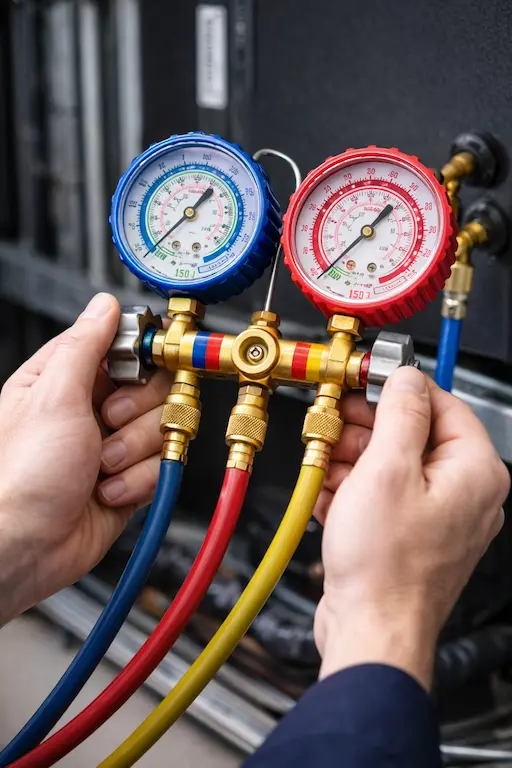
We provide commercial refrigeration services for restaurants and commercial kitchens, grocery and convenience stores, hotels and hospitality operations, healthcare food service facilities, school district kitchens, tribal enterprise food service, breweries and beverage operations, pharmaceutical cold storage, and any commercial facility in Thurston, Pierce, Lewis, Cowlitz, Mason, and Grays Harbor Counties where refrigeration system performance directly affects product safety, food service operations, or inventory value.
EPA 608 certified. AIM Act current. Food safety stakes understood. Western Washington coverage.
Commercial refrigeration has a service problem that shows up most visibly in rural and semi-rural Western Washington markets: when a walk-in fails in Shelton on a Thursday evening or a reach-in goes down in Centralia on a Saturday morning, the facility manager's first call often goes to a general HVAC contractor who doesn't carry commercial refrigerant or isn't familiar with the specific compressor rack configuration serving the case. The result is a longer response time, a technician who's troubleshooting unfamiliar equipment, and a property owner watching product temperature creep toward unsafe territory. Commercial refrigeration requires refrigeration-specific knowledge — compressor rack diagnostics, display case defrost cycle troubleshooting, walk-in temperature differential assessment — that general HVAC service doesn't cover.
Commercial refrigeration service requires refrigeration-specific credentials, refrigeration-specific refrigerants, and a technician who knows that a temperature alarm at 2 AM is a food safety event — not a maintenance ticket.
Elite's EPA Section 608 certification authorizes our technicians to handle all commercial refrigerant work — recovery before any refrigerant circuit is opened, recharging after repair, leak testing on systems with suspected losses, and documentation of all refrigerant quantities as required by federal law. Under the EPA's updated regulations, commercial refrigeration systems holding 15 or more pounds of refrigerant are subject to leak inspection requirements — a threshold that most commercial walk-in and compressor rack systems exceed. Our technicians understand both the current Section 608 compliance requirements and the AIM Act transition timeline for commercial refrigeration refrigerants, so servicing decisions for existing R-404A and R-448A equipment are made with an accurate understanding of the regulatory and supply landscape those refrigerants are operating in.
Commercial refrigeration service contracts for publicly operated food service facilities — tribal enterprise restaurant and hospitality operations, school district kitchen refrigeration, government cafeteria equipment, and healthcare food service — often include supplier diversity requirements. Elite's MWBE (Cert #M1F0027854), DBE (Cert #D1F0027854), and PWSBE (Cert #P000027854) certifications qualify us for those procurement frameworks. As an Indigenous-owned (Cowlitz Tribe) contractor, Elite is particularly well-positioned for tribal enterprise refrigeration service contracts across Western Washington — and we understand the operational expectations of tribal gaming and hospitality facilities where commercial refrigeration reliability is directly tied to food service revenue.
Commercial Refrigeration Within Your Facility's Mechanical Program
Commercial refrigeration systems share mechanical room space and electrical infrastructure with HVAC, boiler, and plumbing systems — and their performance is affected by the same building conditions those systems create. An overheated mechanical room reduces compressor rack efficiency and shortens compressor life. Inadequate make-up air to a kitchen cooler condenser causes high head pressure faults. A refrigeration system without temperature alarm integration to a building automation system produces no alert when the walk-in fails at midnight. Elite’s BAS credentials — Tridium Niagara, JCI Facility Explorer, ABB Cylon BACnet — mean we can integrate commercial refrigeration temperature alarms and setpoint monitoring into a facility’s existing building automation infrastructure, closing the gap between the refrigeration system and the building management platform.
Commercial Refrigeration and the Refrigerant Compliance Landscape
Commercial refrigeration service covers walk-in cooler and freezer repair and maintenance, reach-in unit service, display case and compressor rack diagnostics, refrigerant leak testing and repair, refrigerant recovery and recharging under EPA Section 608, condenser and evaporator coil cleaning, defrost system service, temperature control calibration, and door gasket and hardware service. It is distinct from commercial HVAC and AC service in the refrigerants it uses, the equipment it covers, the food safety stakes of a system failure, and the specific AIM Act compliance requirements that govern refrigerant selection for new and replacement commercial refrigeration equipment.
The EPA’s AIM Act Technology Transitions Program established a 150 GWP maximum for refrigerants used in new food retail refrigeration equipment as of January 1, 2025. This is the threshold that covers supermarket cases, grocery store walk-ins, convenience store coolers, and food service walk-in systems. The refrigerants historically used in these applications — R-404A, which has a GWP over 3,900, and R-448A and R-449A with GWPs around 1,400 — are no longer permitted in new food retail equipment covered by this rule. For existing systems, the transition is less immediate: equipment already running on R-404A, R-448A, or R-449A can continue to be serviced with those refrigerants until the system is replaced or undergoes a major retrofit. The critical implication for facility managers is planning: R-404A availability and cost are already being affected by the phase-out, and equipment purchasing decisions made today should account for the regulatory timeline.
EPA Section 608 of the Clean Air Act governs all commercial refrigerant handling — prohibiting intentional venting, requiring EPA-certified technicians for any work that opens a refrigerant circuit, and establishing leak inspection requirements for commercial systems. Under the EPA’s updated refrigerant management regulations, commercial refrigeration appliances containing 15 or more pounds of refrigerant are subject to annual leak inspection requirements — a threshold that most commercial walk-in systems, compressor rack installations, and multi-case display systems exceed. Facilities that exceed refrigerant charge reporting thresholds have additional documentation obligations. Full details on EPA Section 608 requirements for commercial refrigeration equipment are available at epa.gov/section608.

Our Commercial Refrigeration Service Approach
Commercial refrigeration service starts with understanding the system — what refrigerant it runs, what the compressor rack configuration is, what the normal operating temperatures and pressures are for that system in this facility’s conditions — before diagnosing a fault. Here’s how Elite approaches a commercial refrigeration service call:

System identification and operational history
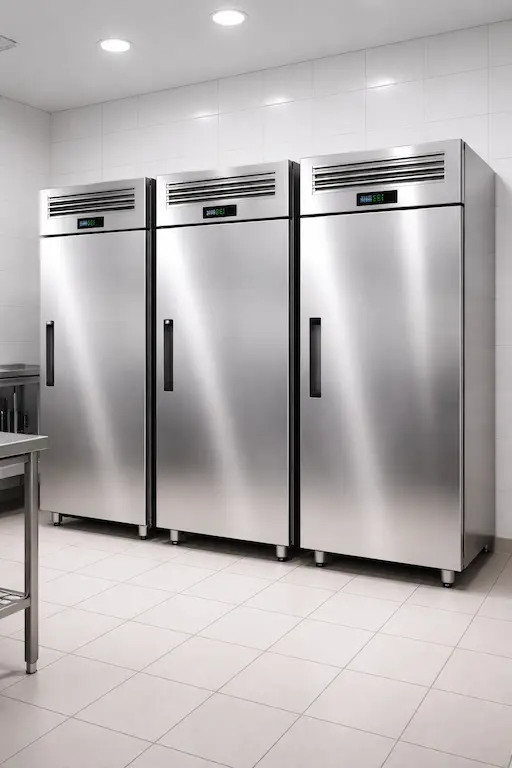
Before diagnosing anything, we identify the system — refrigerant type, compressor configuration (self-contained unit or remote rack), condenser location, evaporator configuration, and defrost type. For compressor rack systems serving multiple cases, we identify which cases are served by which circuit. We review the operational history: when did the problem start, what are the symptoms, has this system had any prior refrigerant additions, and what are the normal operating temperatures for this application. A walk-in cooler with a slow temperature rise has a different diagnostic path than a display case that runs warm only during peak traffic hours.

System measurement under operating conditions
We measure actual system operating conditions against the expected parameters for the refrigerant and application: suction pressure and corresponding evaporating temperature, discharge pressure and corresponding condensing temperature, suction line superheat, liquid line subcooling, and compressor amp draw. These measurements tell us whether the system has a refrigerant charge issue, a heat transfer problem (dirty coils, failed defrost, restricted airflow), a compressor efficiency problem, or a controls issue — and they tell us this from measured data rather than guesswork.

Leak testing
For any system showing low refrigerant charge symptoms, we perform a leak test before adding refrigerant. Adding refrigerant to a leaking system without finding and repairing the leak is not a repair — it's a delay, and under EPA Section 608 it is an environmental compliance issue. We use electronic leak detection on commercial refrigeration systems to locate leaks in evaporator coils, service valves, flare connections, and compressor service ports. The leak is repaired before any refrigerant is added.

Refrigerant recovery, repair, and recharge
Any repair that requires opening the refrigerant circuit — compressor replacement, coil repair, valve replacement — requires refrigerant recovery before the circuit is opened and recharging after. Our EPA Section 608 certified technicians perform recovery with certified recovery equipment, document the quantity recovered, perform the repair, and recharge to manufacturer specification for actual operating conditions. We verify charge by measuring suction superheat and liquid subcooling against the manufacturer's target values — not by weight alone, which does not account for ambient conditions.

Coil cleaning and defrost service
Condenser coil cleaning — the single most impactful maintenance task for commercial refrigeration efficiency — is performed with appropriate coil cleaner for the coil material and fin spacing. A condenser coil with 20% airflow restriction from dirt and debris increases condensing temperature, raises discharge pressure, and stresses the compressor. Evaporator coil condition and defrost cycle function are verified: proper defrost duration, termination control function, and drain line clearance. Ice buildup on the evaporator that doesn't clear on the scheduled defrost cycle indicates either a defrost control failure or an airflow problem, not just a dirty coil.

Temperature verification and documentation
After service, we verify that the refrigerated space returns to setpoint within a reasonable time frame for the cabinet volume and load. We document the service findings, all measured values from the diagnostic assessment, refrigerant quantities handled, and any follow-up recommendations. For facilities with multiple refrigeration units, we provide a status summary covering all units serviced and flag any units approaching end of serviceable life that warrant capital planning attention.
Commercial Mechanical Contractor | Lacey, WA | Founded 2021
Commercial Refrigeration Equipment We Service
Commercial refrigeration equipment spans a wide range of system types across the food service and food retail market. Here’s what Elite services across the commercial refrigeration applications found in Western Washington:
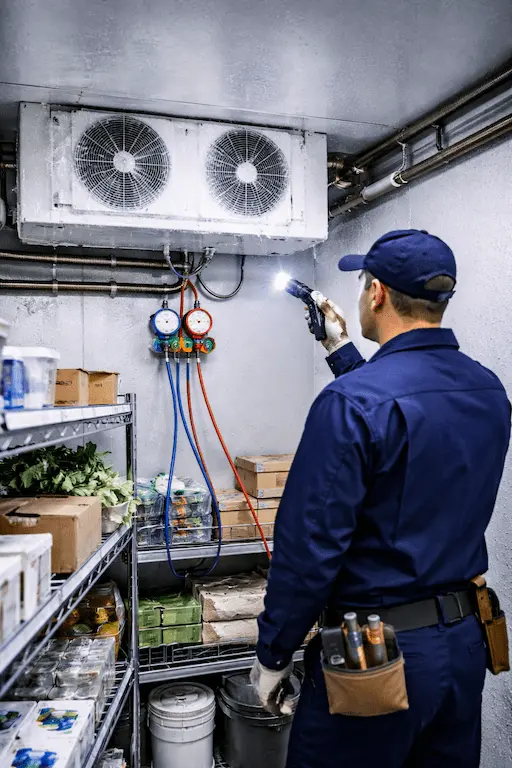
Walk-In Coolers and Freezers
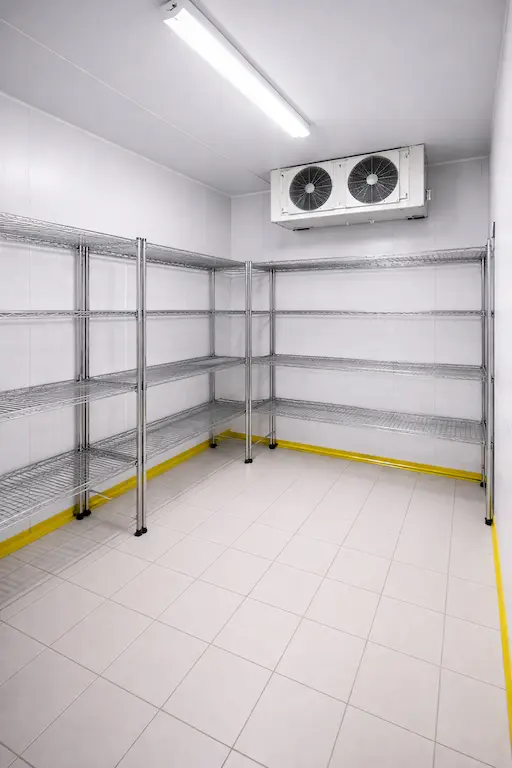
Walk-in coolers and freezers are the refrigeration backbone of restaurants, grocery stores, food distributors, and institutional kitchens. They typically use remote condensing units — a compressor and condenser mounted outside or in a mechanical space — connected by refrigerant lines to an evaporator inside the walk-in. This configuration means the compressor is not visible when standing inside the walk-in, and temperature problems require diagnosis of the full refrigerant circuit, not just the interior unit.
Common walk-in failure modes include refrigerant leaks at the evaporator coil or refrigerant line connections, failed defrost heaters or termination controls producing ice accumulation on the evaporator coil, failed compressor or start components on the condensing unit, dirty condenser coils causing high head pressure lockouts, and door gasket failures that allow warm, humid air to enter and create chronic icing conditions. Elite diagnoses and repairs all of these — and distinguishes between them before recommending a repair, rather than replacing components that don't need replacing.
Reach-In Refrigerators and Freezers
Reach-in commercial refrigerators and freezers — the upright units with solid or glass doors used in restaurant prep lines, bar back-of-house areas, and commercial kitchens — are self-contained systems with the compressor and condenser condensing unit typically located in the base or top of the cabinet. Their self-contained nature means service access requires moving the unit and working in the tight space of the condensing unit compartment. Reach-in units fail most commonly from dirty condenser coils in the condensing unit compartment — a compartment that accumulates grease-laden air from commercial kitchen environments at a rate that residential condensers don't encounter. A reach-in cooler in a busy commercial kitchen may need condenser cleaning every 90 days to maintain the condenser airflow required for efficient operation. Beyond coil cleaning, reach-in service includes refrigerant charge verification, door gasket inspection and replacement, evaporator fan motor service, and thermostat or digital controller calibration.
Display Cases and Compressor Rack Systems
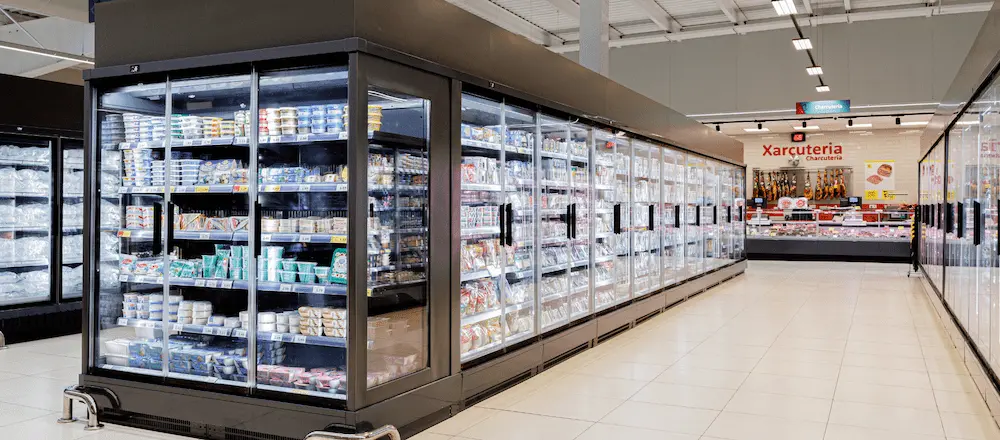
Commercial display cases — the open or glass-front merchandising units in grocery stores, convenience stores, and delis — are typically served by centralized compressor rack systems rather than individual condensing units. A single compressor rack may serve dozens of display cases across a retail floor through a network of refrigerant piping. Diagnosing a temperature problem in a display case served by a rack system requires distinguishing between a case-level problem (defrost issue, fan failure, door seal) and a rack-level problem (compressor fault, refrigerant charge, head pressure) — which requires both case-level and rack-level measurement. Elite services both the display case side and the compressor rack side of retail refrigeration systems. For independent grocery operators, convenience stores, and specialty food retailers in the South Sound who are managing multi-case systems without a full-time refrigeration contractor relationship, Elite provides both emergency repair service and scheduled maintenance programs that address the rack and all connected cases under a single service agreement.
Commercial Ice Machines
Commercial ice machines — cube ice, flake ice, and nugget ice units used in food service, healthcare, and hospitality — have their own distinct maintenance and failure mode profile that differs from other commercial refrigeration equipment. Scale buildup in the water circuit is the most common cause of ice machine service issues, reducing ice production and creating conditions for bacterial growth in the water distribution system. Condenser fouling causes high head pressure faults that reduce ice production and eventually trigger safety shutdowns. Commercial ice machine maintenance includes condenser cleaning, water circuit descaling, water distribution tray and spray bar cleaning, ice thickness sensor calibration, and refrigerant charge verification. For healthcare facilities and food service operations with high sanitation standards, ice machine maintenance documentation is part of the sanitation compliance record — Elite provides the service records that support that documentation requirement.
Temperature Monitoring and BAS Integration
A commercial refrigeration system without a monitored temperature alarm is a liability that reveals itself at the worst possible time — overnight, over a weekend, during a holiday when the facility is closed. A walk-in that fails at 6 PM on a Friday and isn't discovered until 8 AM Monday has lost 38 hours of thermal protection for everything inside it. Elite integrates commercial refrigeration temperature monitoring with facility building automation systems using our Tridium Niagara, JCI Facility Explorer, and ABB Cylon BACnet credentials — routing walk-in temperature alarms to the facility's existing BAS alarm management system or to a monitored notification service. For facilities that don't have a BAS platform, standalone temperature alarm systems with cellular notification can be installed at individual walk-in units to provide overnight and weekend temperature monitoring without requiring a full BAS integration. This is a low-cost insurance policy against the inventory loss and health department exposure that an unmonitored refrigeration failure creates.
One Contractor. Every System. The Whole Region.
Don’t find out your walk-in failed at 5 AM by opening the door. Contact Elite Mechanical Services at (360) 489-0717 to schedule commercial refrigeration service or discuss temperature alarm integration for your facility. We serve commercial operations across Lacey, Olympia, Tumwater, Tacoma, and Western Washington.
Commercial Refrigeration Across Western Washington
Restaurants and Food Service — Thurston and Pierce County Concentration
The South Sound’s restaurant and food service market — concentrated in Lacey, Olympia, Tumwater, Tacoma, and Puyallup — operates commercial refrigeration equipment that runs continuously, 365 days a year, under the demanding conditions of a working commercial kitchen. Kitchen reach-in condensers accumulate grease-laden air on their condenser coils at rates that require quarterly cleaning in high-volume kitchens to maintain operating efficiency. Walk-in coolers serving restaurant kitchens open dozens of times per day, placing continuous demand on door gaskets and creating thermal cycling stress that accelerates wear on seals and compressor components. Elite provides both reactive repair service when equipment fails and scheduled maintenance programs calibrated to the demands of commercial kitchen refrigeration — including the quarterly reach-in condenser cleaning that high-volume kitchens need but rarely schedule before the equipment stops performing.
Grocery, Convenience, and Food Retail
The independent grocery and specialty food retail market in Western Washington — natural food stores, ethnic grocery operations, specialty meat markets, and beverage retailers — typically operates compressor rack systems serving multiple display cases. These operations don’t have the refrigeration maintenance resources of a national chain, but they depend on the same critical refrigeration infrastructure. A rack compressor failure during summer peak can take down an entire case line simultaneously, with immediate product loss across every case the rack serves. Elite provides compressor rack service, display case maintenance, and refrigerant management for independent food retail operators throughout Thurston, Pierce, Lewis, Cowlitz, Mason, and Grays Harbor Counties — including operators in smaller markets where independent refrigeration contractors are scarce.
Healthcare and Pharmaceutical Cold Storage
Healthcare facilities in Western Washington — hospitals, outpatient surgical centers, pharmacies, medical clinics, and residential care facilities — operate commercial refrigeration equipment under stricter temperature compliance requirements than food service. Pharmaceutical refrigerators and freezers must maintain precise temperature ranges for medication and specimen integrity, with continuous temperature logging required for compliance. Walk-in coolers in hospital food service operations operate under the same health code framework as restaurant walk-ins but with patient safety context that makes a temperature excursion a reportable event. Elite provides commercial refrigeration service for healthcare refrigeration applications with the documentation standards and scheduling approach that healthcare operational requirements demand.
- Restaurants and commercial kitchens with walk-in and reach-in refrigeration
- Grocery and specialty food retail with display case and compressor rack systems
- Hotels and hospitality operations with commercial kitchen and bar refrigeration
- Healthcare facilities with pharmaceutical cold storage and food service refrigeration
- Tribal enterprise food service and hospitality operations
- School district kitchens and institutional cafeteria refrigeration
- Convenience stores and beverage retailers with display case systems
- Breweries and beverage production operations
- Food processing and cold storage facilities
- Any facility where a refrigeration failure means immediate product loss or health code exposure
Facilities We Serve for Commercial Refrigeration
The common denominator across every commercial refrigeration client is that the equipment can’t fail without immediate operational and financial consequences. A restaurant without a functioning walk-in can’t open for service. A pharmacy without a functioning vaccine refrigerator has a reporting obligation. A grocery store with a failed display case has visible product loss and a health department interaction. Elite approaches commercial refrigeration with that urgency as the baseline, not the exception.
Commercial refrigeration service only — no household refrigerators, no residential freezers. Commercial refrigeration systems use different refrigerants, operate under federal regulatory requirements that residential systems don’t, and carry food safety and business continuity stakes that residential equipment doesn’t. Our technicians are calibrated to the commercial standard exclusively.
Commercial Refrigeration Service Area — Western Washington
Serving Rural and Remote Western Washington Markets
Commercial refrigeration contractor access in rural Western Washington markets — Mason County, Lewis County, Grays Harbor County, and the more remote parts of Cowlitz County — is genuinely limited. When a walk-in fails at a tribal enterprise in Shelton, a grocery store in Chehalis, or a restaurant in Aberdeen, the local service options are often a general HVAC contractor who carries some refrigerant but isn’t familiar with commercial rack systems, or a long wait for a specialty refrigeration contractor from the Thurston or Pierce County core market. Elite covers this full footprint consistently as a standard part of our service area — with the EPA Section 608 certification, the commercial refrigerant stock, and the diagnostic equipment that commercial refrigeration service requires.
Thurston and Pierce County Core
In Thurston County — our home market — the restaurant and food service concentration in Lacey, Olympia, Tumwater, and the Hawks Prairie commercial corridor generates steady commercial refrigeration demand. Pierce County’s Tacoma, Lakewood, University Place, and Puyallup markets add the healthcare facility refrigeration demand and the independent grocery and specialty food retail sector that characterizes that market. For commercial operators in these markets, Elite offers both emergency response for equipment failures and annual maintenance agreements that prevent the emergency from occurring.
Multi-Site Programs
For organizations managing refrigeration equipment across multiple locations — a regional convenience store chain, a tribal enterprise with food service at multiple facilities, a school district with kitchen refrigeration at multiple campuses — Elite structures refrigeration maintenance agreements that cover all sites under a single program. Coordinated service scheduling, consistent documentation across all sites, and a single point of contact for all refrigeration service needs within the Western Washington footprint.
Review our full service area across Western Washington, or call (360) 489-0717 to discuss your facility’s refrigeration service needs.
Why Choose Elite for Commercial Refrigeration Services
Commercial refrigeration service is a discipline where both the urgency and the regulatory complexity are higher than in any other mechanical system category. The urgency is food safety — a temperature excursion in a commercial walk-in has health code, liability, and business continuity implications that a building that’s too warm for a few hours doesn’t. The regulatory complexity is the AIM Act transition — a technician who doesn’t understand what R-404A phase-out means for your existing equipment’s servicing horizon isn’t giving you complete information.
Elite’s EPA Section 608 certification, current knowledge of the AIM Act commercial refrigeration timeline, and experience with the specific refrigerants and equipment configurations found in Western Washington food service operations is what makes the difference between a service call that solves the problem and one that postpones it.
- EPA Section 608 certified — all commercial refrigerant recovery, recharging, leak testing, and documentation legally compliant
- AIM Act current — informed on commercial refrigeration refrigerant transition timeline and R-404A phase-out implications
- GC License: ELITEMS796R2 | Electrical License: ELITEMS787CH — full mechanical and controls scope in-house
- Tridium Niagara | JCI Facility Explorer | ABB Cylon BACnet — temperature alarm integration with building automation systems
- Union contractor — union-trained technicians on every commercial refrigeration service call
- MWBE Cert #M1F0027854 | DBE Cert #D1F0027854 | PWSBE Cert #P000027854 — qualified for public and tribal facility service contracts
- Bond capacity: $750,000 single project | $1.2 million aggregate
- Founded 2021 | Minority-owned, woman-owned, Indigenous-owned (Cowlitz Tribe), Latino-owned
Commercial refrigeration equipment doesn’t give much warning before it fails. A compressor that’s been running above its normal amp draw for three weeks fails on a Friday night. A condenser coil that’s 40% blocked with grease and debris causes a high-pressure lockout on the hottest afternoon of the year. A defrost heater that stopped working six weeks ago produces enough ice on the evaporator coil to block airflow entirely — on the day before a health inspection. Scheduled maintenance catches all three before they become emergencies. Elite’s commercial refrigeration maintenance programs are designed to find these conditions on a scheduled service call, not in the context of a product-loss emergency.
What refrigerants does Elite use for commercial refrigeration service?
Elite services commercial refrigeration equipment using the refrigerants appropriate for each system and application. Existing commercial refrigeration systems commonly use R-404A, R-448A, R-449A, or R-134a depending on the equipment type and age. Newer systems being installed under AIM Act compliance use lower-GWP alternatives including R-454A and R-454C for medium and low temperature commercial refrigeration applications. Our EPA Section 608 certified technicians handle recovery, recharging, and leak testing for all of these refrigerant types. For existing systems running on R-404A — which is being phased out under the AIM Act — we can discuss the servicing horizon for your specific equipment and what a planned transition to lower-GWP refrigerants or replacement equipment looks like versus an emergency replacement driven by refrigerant unavailability.
What is included in a commercial refrigeration maintenance visit?
A standard Elite commercial refrigeration maintenance visit covers: condenser coil cleaning and inspection; evaporator coil condition assessment; defrost cycle operation verification; refrigerant charge measurement under operating conditions (suction superheat and liquid subcooling); leak testing for systems showing low charge symptoms; compressor amp draw measurement; door gasket inspection; temperature control calibration; and a written service record documenting all measurements and findings. For walk-in systems, we also verify that drain lines are clear and that the floor heater (where installed) is functioning to prevent ice buildup under the floor. For compressor rack systems, we assess rack pressure controls, oil levels, and individual compressor performance. The service record documents all measured values so you have a baseline for comparison at the next service visit.
Does Elite integrate commercial refrigeration temperature alarms with building automation systems?
Yes. For facilities with a Tridium Niagara, JCI Facility Explorer, or ABB Cylon BACnet building automation system, Elite can integrate walk-in cooler and freezer temperature points into the existing BAS alarm management system — routing temperature excursion alarms to the same notification system that handles HVAC and boiler faults. This means a refrigeration failure at 2 AM generates the same alarm notification as any other critical building system fault, rather than being discovered when a kitchen employee opens the walk-in the next morning. For facilities without a BAS platform, standalone cellular temperature alarm systems can be installed at individual walk-in units to provide overnight and weekend monitoring. The cost of a temperature alarm system is a fraction of one night’s product loss in a commercial walk-in.
What does the AIM Act mean for my existing commercial refrigeration equipment?
The AIM Act's Technology Transitions Program established a 150 GWP maximum for refrigerants in new food retail refrigeration equipment as of January 1, 2025. This means new commercial refrigeration equipment — walk-in coolers, display cases, compressor racks — installed after January 1, 2025 must use refrigerants with a GWP below 150. Your existing equipment running R-404A, R-448A, or R-449A is not required to be replaced or retrofitted on any deadline — those refrigerants can continue to be used to service existing equipment. The practical implication is supply and cost: R-404A availability is declining as production decreases under the AIM Act HFC phase-down, and its price has increased as a result. Facilities with aging R-404A equipment should factor refrigerant availability into their capital planning discussions rather than waiting for an emergency failure to force a replacement decision.
How quickly can Elite respond to a commercial refrigeration emergency?
Commercial refrigeration emergencies — a walk-in that's lost temperature, a compressor rack that's tripped off overnight, a display case that's warming — are scheduled as priority service calls. Our Western Washington service footprint means response time varies by location: Thurston and Pierce County facilities typically see same-day or next-morning response; Lewis, Cowlitz, Mason, and Grays Harbor County facilities in more rural locations may require scheduling to the following day depending on our current service calendar. If you have a refrigeration emergency in progress, call (360) 489-0717 directly rather than using the online quote form — phone calls get an immediate response from our office team who can assess the situation and schedule a technician.
Commercial Mechanical Contractor | Lacey, WA | Founded 2021
Frequently Asked Questions
Your Walk-In Should Have an Alarm. Your Technician Should Know What R-404A Means.
Elite Mechanical Services provides commercial refrigeration repair, maintenance, and refrigerant service for walk-ins, reach-ins, display cases, compressor racks, and ice machines across Lacey, Olympia, Tumwater, Tacoma, and Western Washington. EPA Section 608 certified. AIM Act current. BAS integration capable. Call (360) 489-0717, email admin@elitemechsvcs.com, or fill out our online quote request form.