Commercial Boiler Installation in Lacey, WA
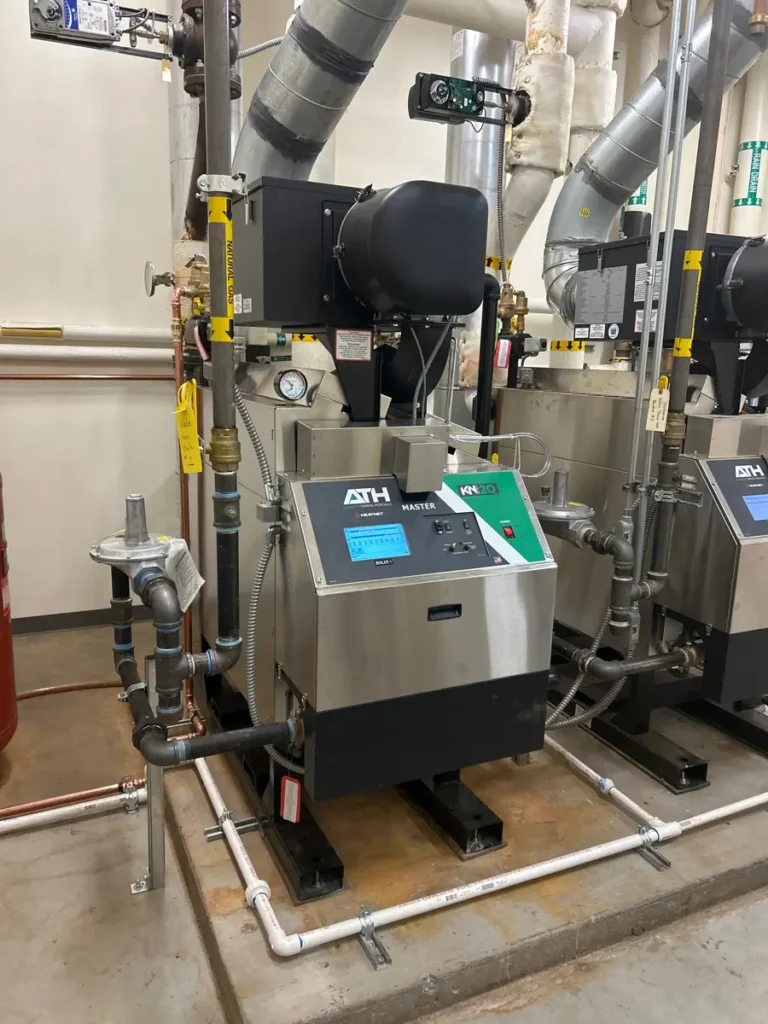
Commercial boiler installation in Washington state is not a job that tolerates cutting corners on credentials or skipping the permit process. Under RCW 70.79 and WAC 296-102, every commercial boiler installation requires an L&I permit filed before work begins — with an L&I inspector assigned to the project who must be notified and present for inspection before the system can be placed in service. Equipment must conform to ASME Boiler and Pressure Vessel Code. The City of Seattle specifically requires a Grade III Boiler Supervisor for licensed boiler work within city limits. These aren’t bureaucratic formalities — they exist because an improperly installed commercial boiler is a pressure vessel capable of catastrophic failure. Elite Mechanical Services holds a Seattle Grade III Boiler Supervisor credential and Boiler License #LIC-BO-1670, covering commercial boiler installation across Lacey, Olympia, Tumwater, Tacoma, and the full Western Washington service footprint.
Beyond the regulatory requirements, commercial boiler installation demands genuine hydronic system design competency — heat loss calculations, primary and secondary loop configuration, pump sizing, expansion tank selection, combustion air management, and BAS integration. A boiler that’s correctly installed as a pressure vessel but incorrectly configured as a heating system will underperform, short-cycle, or fail to deliver the building’s heating load when outdoor temperatures drop. Elite’s boiler installations start with heat loss calculations, not equipment assumptions. We hold an Intellihot IntelliPRO contractor credential covering Intellihot’s commercial tankless water heating systems, a GC License (ELITEMS796R2) and Electrical License (ELITEMS787CH) for the full mechanical and controls scope, and union labor standards on every installation project.
Contact Elite Mechanical Services at (360) 489-0717
Commercial Mechanical Contractor | Lacey, WA | Founded 2021
What Sets Elite Apart for Commercial Boiler Installation
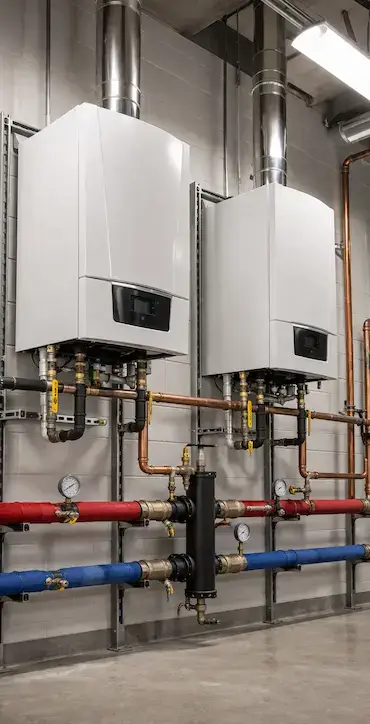
Grade III Boiler Supervisor. L&I permitted. ASME compliant. From heat loss calculation to commissioning.
The South Sound commercial heating market has a consistent problem with boiler installation: general HVAC contractors who occasionally install boilers without the proper credentials, skip the L&I permit process, and hand over a system that has never been inspected by an L&I boiler inspector. The building owner doesn't discover this until a boiler inspection triggers a notice of violation, an insurance claim is denied because the installation wasn't permitted, or a system failure raises questions about whether the equipment was legally installed. Commercial boilers are regulated pressure vessels under Washington state law — the permit and inspection process exists to protect the building and its occupants, not to add paperwork to a contractor's project.
Every Elite boiler installation is filed with L&I before work starts, inspected by an assigned L&I boiler inspector, and closed out with a Certificate of Inspection on file.
Elite's Grade III Boiler Supervisor credential (Boiler License #LIC-BO-1670) represents the credential tier that Washington state and the City of Seattle recognize for commercial boiler supervision — earned through examination covering boiler theory, ASME codes, safety controls, and emergency procedures. This is distinct from a general HVAC contractor license. Beyond the boiler-specific credential, Elite holds GC License ELITEMS796R2 for the full mechanical scope, Electrical License ELITEMS787CH for controls wiring, and Intellihot IntelliPRO contractor certification for Intellihot's commercial tankless boiler product line. Our union-trained installation technicians are calibrated to the documentation and safety standards that ASME-coded boiler work requires.
Public institutions with boiler-heated facilities — school districts, tribal housing authorities, government campus facilities, and healthcare institutions — frequently operate under procurement frameworks that include supplier diversity requirements. Elite's MWBE (Cert #M1F0027854), DBE (Cert #D1F0027854), and PWSBE (Cert #P000027854) certifications make us a qualified vendor for those procurement processes. In Western Washington, many of the largest boiler replacement projects are publicly funded — aging boiler plants in school buildings, tribal facility heating systems, and government buildings operating legacy steam equipment that is past its serviceable life. Elite has both the technical credentials and the procurement certifications to bid and deliver those projects.
Our boiler installation work spans the commercial and institutional spectrum: hospitals and healthcare campuses with steam or hot water heating distribution, K-12 school districts replacing aging boiler plants, tribal facilities in rural and semi-rural Western Washington communities, government buildings transitioning from legacy steam to modern condensing hot water systems, hotels with high domestic hot water demand, multi-unit residential and mixed-use properties, and industrial facilities with process heating requirements.
Related Commercial Mechanical Services
A boiler installation rarely stands alone. The hydronic distribution system, the controls integration with building automation, the domestic hot water plumbing connections, and the ongoing maintenance program are all part of the same mechanical ecosystem. Elite covers the full scope — commercial plumbing under License #ELITEMS761BC, BAS integration under Tridium Niagara and JCI Facility Explorer credentials, and preventative maintenance programs that include boiler-specific inspection and compliance documentation. Installing and maintaining under one contractor means the hydronic system design assumptions that drove the installation are still understood when the maintenance visit happens three years later.
What Commercial Boiler Installation Actually Involves in Washington State
Commercial boiler installation in Washington state covers heat loss calculation, equipment selection, hydronic system design, L&I permit application, ASME-compliant installation, combustion air management, primary and secondary loop piping, safety control wiring, BAS integration, combustion analysis, pressure testing, and L&I inspection before the system is placed in service. It is regulated work under RCW 70.79 and WAC 296-102 — requiring a permit from the Washington State Department of Labor and Industries before installation begins, and a Certificate of Inspection from an L&I boiler inspector before the equipment can be legally operated.
Commercial boiler installations that skip the L&I permit process — or that are performed by contractors without the appropriate boiler credentials — create documented liability for the building owner. An unpermitted commercial boiler installation is a code violation under Washington state law. An installed boiler that has not received a Certificate of Inspection from an L&I inspector cannot be legally operated. If the equipment fails and causes property damage, personal injury, or a fire, an unpermitted installation will affect every aspect of the insurance claim and any subsequent legal proceeding. Washington’s commercial building stock has a meaningful number of boilers in exactly this situation — installed by contractors who didn’t understand or chose not to follow the permitting requirement. The liability belongs to the building owner, not the contractor who has since moved on.
Washington’s commercial boiler installation requirements fall under the jurisdiction of the L&I Boiler Program, administered under Chapter 70.79 RCW and WAC 296-104. The installation permit must be filed and approved before work begins — not after. An L&I boiler inspector is assigned to the project at the time of permit issuance and must be contacted by the installer when the installation is ready for inspection. Washington’s 2021 Commercial Energy Code (Section C403.3.4) also establishes efficiency requirements and combustion air controls for newly installed boiler systems with input capacities at or above 2,500,000 BTU/hr. Full details on the L&I boiler permit process, fees, and inspection requirements are available at the Washington State Department of Labor and Industries Boiler Program page at lni.wa.gov.
Your facility is a candidate for commercial boiler installation or replacement if any of these conditions apply: your existing boiler is more than 20 years old and has had increasing repair frequency over the past three years; your system is a legacy steam boiler serving spaces that would perform better with a modern low-temperature hot water distribution system; you are constructing a new commercial or institutional building that will use hydronic heating; you need domestic hot water heating at scale and your current water heater infrastructure is inadequate; or your existing boiler was installed without an L&I permit and you need to bring the installation into compliance. All four scenarios are common in Western Washington’s commercial building inventory.

Our Commercial Boiler Installation Process
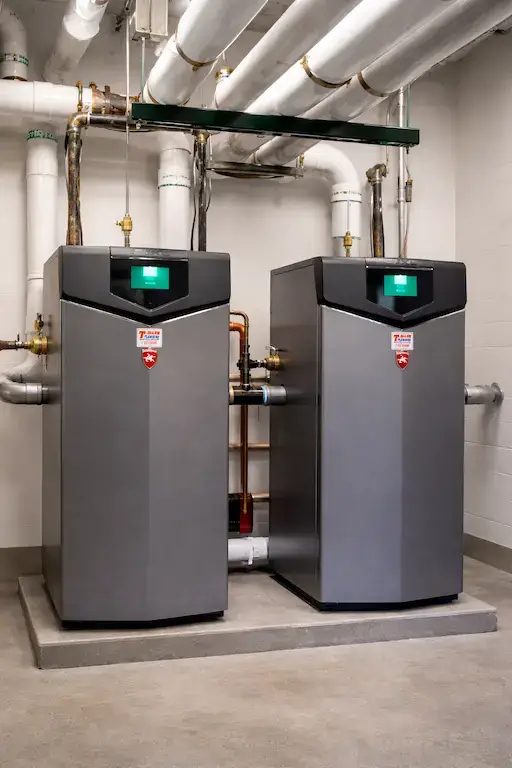
Every Elite boiler installation begins with a heating load calculation and a review of the existing hydronic distribution system — or a design session for new construction. The boiler is only one component in a heating system that includes pumps, expansion tanks, mixing valves, distribution piping, heat emitters, and controls. Getting the boiler right requires understanding the whole system. Here’s how we approach it:
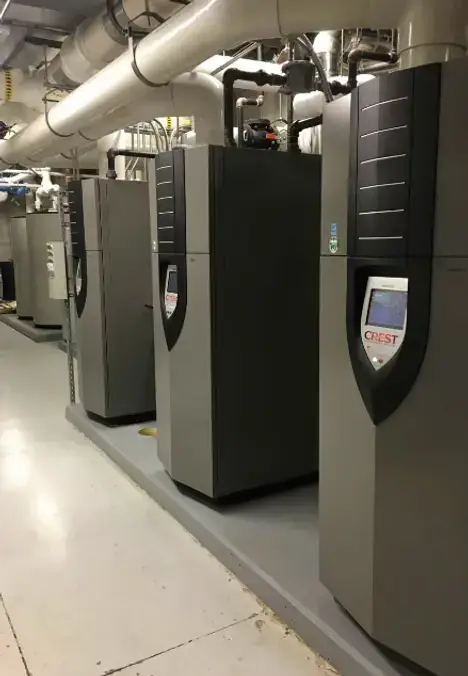

Heating load calculation and system assessment
We calculate the facility's heating load — accounting for building envelope, glazing, occupancy, domestic hot water demand, and any process heating requirements. For boiler replacements, we also assess the existing distribution system: piping configuration, heat emitters, pump sizing, and controls infrastructure. The load calculation determines required boiler output capacity. The system assessment determines whether the existing distribution infrastructure is compatible with the new equipment or requires modification.
System design and equipment specification
Based on load requirements, we specify the boiler type, firing rate, efficiency rating, and configuration — single unit, modular cascade, or primary/secondary with multiple boilers — along with pump sizing, expansion tank capacity, mixing valve configuration, and controls architecture. For Intellihot tankless installations, we specify the number of units required to meet simultaneous demand and the recirculation loop configuration. We provide a complete equipment specification with manufacturer's data submittals before ordering.

L&I permit application
We file the boiler installation permit application with the Washington State Department of Labor and Industries before any installation work begins — as required by WAC 296-102. The permit application includes equipment identification, installation location, and installer credentials. L&I assigns an inspector to the project at permit issuance. We manage all communication with the assigned L&I inspector, notify them when the installation is ready for inspection, and coordinate their site visit.

Installation, piping, and controls
Our union-trained technicians perform the full installation scope — equipment setting, gas line connections, flue and combustion air systems per ASME code requirements, hydronic piping connections including primary and secondary loop configuration where applicable, expansion tank installation, safety relief valve and low-water cutoff wiring, and BAS integration for remote monitoring and setpoint management. Boiler room clearances are maintained per ASME and L&I requirements throughout.

Combustion analysis, pressure testing, and startup
Before L&I inspection, we conduct a full startup sequence: pressure testing the hydronic circuit, verifying all safety controls function correctly (low-water cutoff, high-limit controls, pressure relief, combustion air interlock), performing combustion analysis to verify proper fuel-to-air ratio and flue gas composition, and verifying system pressures and temperatures against design specifications. We do not request the L&I inspection until the system is confirmed to be operating correctly — because a failed inspection creates schedule risk for the project.

L&I inspection, Certificate of Inspection, and documentation handoff
The L&I boiler inspector conducts the installation inspection and issues a Certificate of Inspection upon passing. We provide the building owner with complete project documentation: as-built drawings, equipment submittals, Certificate of Inspection, combustion analysis records, warranty registration, and operator training for your facilities team. The Certificate of Inspection must be posted at or near the boiler — we make sure this requirement is met at project closeout.
Commercial Mechanical Contractor | Lacey, WA | Founded 2021
Commercial Boiler Types We Install
Commercial boiler selection is a design decision, not a purchasing decision. The right system type depends on the facility’s heat distribution infrastructure, domestic hot water demand, available fuel source, boiler room footprint, required redundancy, and efficiency targets. Here’s what Elite installs and what drives the selection for each type:
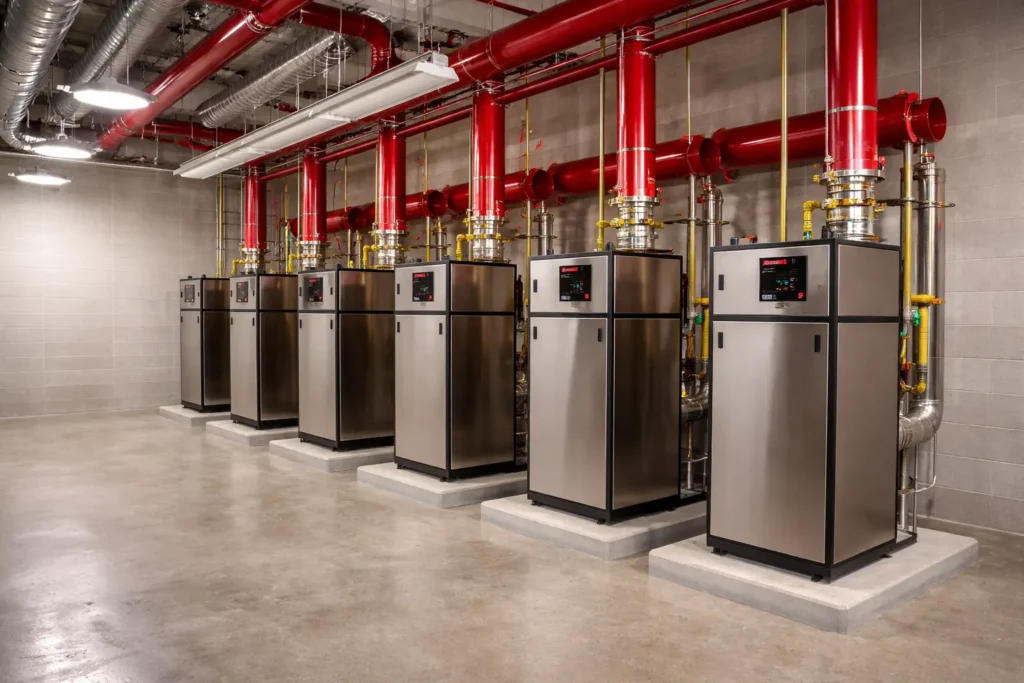
Condensing High-Efficiency Hot Water Boilers
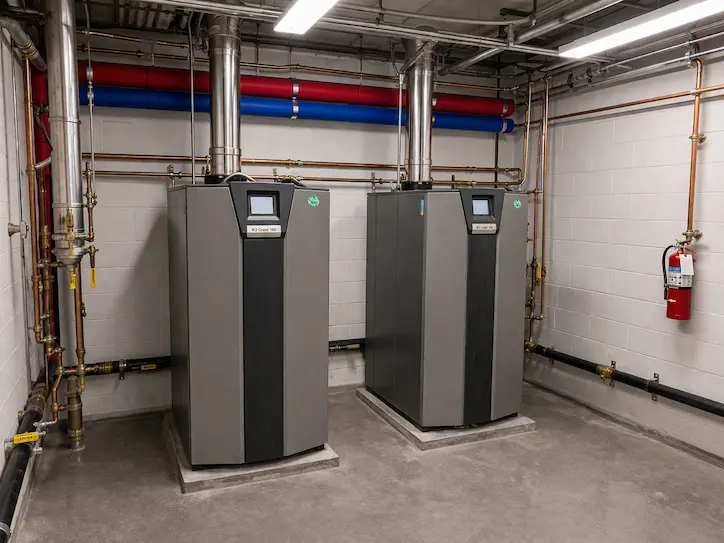
Condensing boilers extract heat from flue gases by cooling combustion products below the dew point — recovering latent heat that conventional boilers exhaust through the flue. Gas-fired condensing hot water boilers can achieve thermal efficiency ratings of 95 to 99%, compared to roughly 80% for standard commercial hot water boilers. The efficiency gain is real and substantial — on a large commercial heating load, the difference between 80% and 95% efficiency translates directly to natural gas consumption and operating cost. Condensing efficiency is maximized when the boiler operates with return water temperatures below 130°F. This makes condensing boilers particularly well-suited for modern low-temperature hydronic distribution systems — radiant floor heating, low-temperature fan coils, and properly designed forced hot water systems. For older distribution systems designed around higher water temperatures, a condensing boiler may not achieve its rated efficiency without distribution modifications. Elite's design process includes an assessment of return water temperatures before specifying condensing equipment.
Modular Cascade Boiler Systems
Modular cascade installations use multiple smaller boilers operating in sequence — bringing units online as demand increases and reducing to a single unit at low loads — to achieve high turndown ratios and redundancy that a single large boiler cannot match. In a cascade configuration, if one boiler requires service, the remaining units continue to meet load. The system never loses total heating capacity due to a single equipment failure, which matters enormously in occupied buildings during a Western Washington winter. Cascade configurations also allow boiler replacement one unit at a time over the system's lifecycle — reducing the capital impact of a full boiler plant replacement. For school districts and institutional clients managing aging boiler infrastructure across multiple buildings, modular cascade design provides a realistic path to incremental system modernization without a single large capital expenditure.
Steam Boilers
Steam boiler installations serve specific commercial and institutional applications where steam is required for process use, sterilization, humidification, or legacy distribution systems that were designed for steam before low-temperature hot water systems became the standard. Many of the largest commercial and institutional buildings in Western Washington — hospitals, older school buildings, government campus facilities — have steam distribution infrastructure that was installed decades ago. The piping, radiators, and steam traps throughout those buildings represent capital that's already been spent and systems that still function — which makes full distribution conversion a harder decision than simply replacing the boiler that drives them. Elite installs low-pressure steam boilers for facilities where the steam distribution system is sound and the priority is replacing aging boiler equipment rather than converting the distribution system. For facilities considering a conversion from steam to hot water, we provide a system assessment covering the scope and cost of distribution modification — giving the building owner the information to make an informed choice between steam boiler replacement and full system conversion.
Hydronic System Integration and Primary/Secondary Loop Design
Modern commercial boiler installations in buildings with multiple zones, variable flow distribution, or mixed temperature requirements typically use a primary/secondary loop configuration — a dedicated boiler loop operating at constant flow, with secondary circuits serving individual zones at variable flow rates controlled by modulating pumps and mixing valves. This configuration decouples the boiler's flow requirements from the distribution system's variable demands, protecting condensing equipment from high return water temperatures that would impair efficiency and protecting conventional boilers from thermal shock. Elite designs and installs primary/secondary hydronic configurations as part of our boiler installation scope. We size the primary loop pump, specify the secondary circuit pumps and mixing valves, and configure the controls to manage each circuit independently while optimizing the boiler's operating conditions. For projects integrating with a Tridium Niagara or JCI Facility Explorer BAS, we program the boiler controls integration as part of the installation — not as an afterthought.
One Contractor. Every System. The Whole Region.
Ready to plan your commercial boiler installation? Elite handles the L&I permit, the ASME-compliant installation, the inspector coordination, and the Certificate of Inspection — so you don’t have to track down what your previous contractor skipped. Call (360) 489-0717 or fill out our online contact request form.
Commercial Boiler Installation Across Western Washington
Institutional Heating Plants — Schools and Government
Thurston County’s K-12 school buildings contain some of the oldest active commercial boiler plants in Western Washington — cast iron sectional boilers and fire-tube steam systems that have been patched and extended well past their design lives. School districts across Thurston, Lewis, and Mason Counties face the same capital planning challenge: aging boiler infrastructure that is increasingly unreliable, expensive to maintain, and operating at efficiency ratings that are 20 to 30 percentage points below what modern condensing equipment would deliver. Elite’s work with public school facilities includes complete boiler plant replacement — removing the legacy equipment, designing the replacement system to match the distribution infrastructure, filing the L&I permit, managing the installation within the school’s operating calendar, and completing the Certificate of Inspection. Our MWBE, DBE, and PWSBE certifications qualify us for the procurement processes that govern public school and government building mechanical projects throughout Washington state.
Healthcare and High Hot Water Demand Facilities
Hospitals, outpatient surgery centers, and residential healthcare facilities in the South Sound operate domestic hot water systems under demand profiles that are among the most challenging in commercial construction — high simultaneous demand during shift changes, continuous recirculation requirements, and strict temperature maintenance requirements for Legionella prevention under ASHRAE 188 guidelines. These facilities cannot tolerate domestic hot water system failure. For healthcare clients in Tacoma, Olympia, Lacey, and throughout Pierce and Thurston Counties, Elite installs Intellihot tankless commercial systems and high-capacity condensing boiler configurations designed around the facility’s actual demand curve — not rules of thumb that may undersize the system during peak demand periods. All healthcare boiler work is conducted under the appropriate L&I permit with the Certificate of Inspection delivered to the facility compliance team.
Tribal Facilities and Rural Communities
Tribal facilities and rural commercial buildings in Mason, Lewis, Grays Harbor, and Cowlitz Counties represent a segment of the Western Washington commercial boiler market that receives less contractor attention than the Thurston and Pierce County core. Access to licensed, credentialed commercial boiler contractors in these communities is genuinely limited — which means aging boiler equipment often runs beyond its safe service life without qualified service, and new construction in these communities sometimes accepts contractors who lack the proper boiler credentials because credentialed alternatives are not actively competing for the work. Elite is actively building relationships with tribal housing authorities, tribal gaming facilities, and rural commercial clients throughout Western Washington — bringing the same L&I permit compliance, ASME code adherence, and Grade III Boiler Supervisor credential to projects in Shelton, Chehalis, Aberdeen, and Kelso that we bring to Lacey and Olympia.
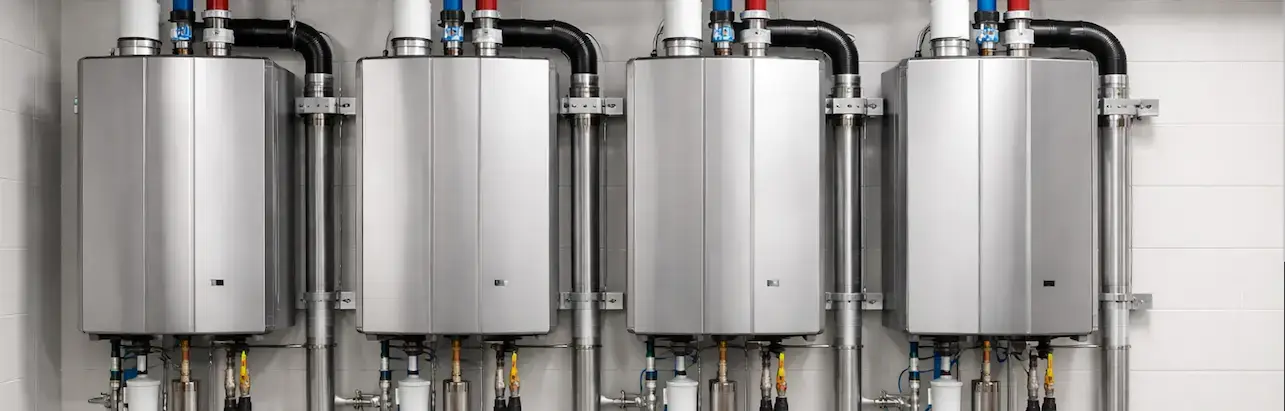
- K-12 schools and community colleges with aging boiler plant infrastructure
- Hospitals, surgical centers, and residential healthcare facilities
- Tribal facilities — housing authorities, gaming operations, community centers
- Hotels and hospitality properties with high domestic hot water demand
- Multi-unit residential and mixed-use buildings with central hydronic heating
- Government and municipal buildings transitioning from steam to hot water
- Industrial facilities with process heating requirements
- New commercial construction requiring central hot water heating systems
- Facilities with legacy steam boilers approaching end of serviceable life
- Publicly funded projects requiring MWBE, DBE, or PWSBE certified contractors
Buildings and Facilities We Install Commercial Boilers For
Commercial boiler installation requires a contractor with the right credentials for the equipment type, the right understanding of the hydronic distribution system, and the discipline to run the L&I permit process correctly from start to finish. Not all of these things are present at the same contractor in the South Sound market. Elite brings all three, on every boiler installation, for every client.
We install commercial boilers only — no residential water heaters, no home heating systems. Commercial boiler work operates under a regulatory framework and technical standard that residential work simply doesn’t encounter, and our technicians are trained to that standard exclusively.
Boiler Installation Service Area in Western Washington
Where We Serve
Elite Mechanical Services installs commercial boilers across all six counties in our Western Washington service footprint — Thurston, Pierce, Lewis, Cowlitz, Mason, and Grays Harbor. Our Lacey, WA base gives us efficient access to the dense commercial and institutional market in the South Sound core, but we regularly work in communities where commercial-grade boiler contractors are scarce: Shelton in Mason County, the Lewis County I-5 corridor from Centralia through Chehalis to Winlock, coastal Grays Harbor facilities in Aberdeen and Hoquiam, and Cowlitz County’s Longview and Kelso market.
Pierce County and Tacoma
Pierce County’s commercial boiler installation market is anchored by Tacoma’s healthcare campus concentration, the Lakewood and University Place commercial corridor, and the active commercial construction market in DuPont and Puyallup. Healthcare facilities in this market routinely require high-capacity domestic hot water systems and complex hydronic heating configurations — work that demands both the Intellihot IntelliPRO credential for tankless system installations and the Grade III Boiler Supervisor credential for the regulated boiler equipment. Elite serves Pierce County boiler installation projects with the same L&I permitting discipline and ASME compliance we apply throughout our service area.
Multi-Building and Multi-Site Projects
School districts, tribal enterprises, and government agencies managing boiler infrastructure across multiple facilities in our service area can consolidate boiler installation projects under a single contract with Elite. Multi-site projects benefit from a consistent design approach — standardizing equipment where the heating loads are similar, maintaining a single set of as-built documentation across the portfolio, and working with a contractor who knows the existing systems at every site rather than starting from scratch at each building.
Contact us at (360) 489-0717 to discuss your facility’s location and boiler installation scope, or review our service area across Western Washington.
Why Choose Elite for Commercial Boiler Installation
When a Washington state boiler inspector reviews an installation and finds problems, the liability lands on the owner — not the contractor. The Certificate of Inspection is the owner’s documentation that the installation was performed correctly under state oversight. Elite’s Grade III Boiler Supervisor credential, Boiler License #LIC-BO-1670, and consistent L&I permit compliance mean every boiler installation we complete produces the certificate and documentation the building owner is entitled to receive — and that the state requires them to have on file.
- Seattle Grade III Boiler Supervisor | Boiler License #LIC-BO-1670 — the credential Washington state and the City of Seattle require for commercial boiler work
- Intellihot IntelliPRO Contractor — factory-certified for Intellihot commercial tankless boiler installation and commissioning
- GC License: ELITEMS796R2 — full mechanical scope under one licensed contractor
- Electrical License: ELITEMS787CH — controls wiring and BAS integration without a separate electrical subcontractor
- Plumbing License: ELITEMS761BC — hydronic piping and domestic hot water connections in-house
- Union contractor — union-trained installation technicians on every boiler project
- Tridium Niagara | JCI Facility Explorer | ABB Cylon BACnet — boiler BAS integration capable
- MWBE Cert #M1F0027854 | DBE Cert #D1F0027854 | PWSBE Cert #P000027854
- Bond capacity: $750,000 single project | $1.2 million aggregate
- Founded 2021 | Minority-owned, woman-owned, Indigenous-owned (Cowlitz Tribe), Latino-owned
The difference between a commercial boiler installation that closes out correctly and one that creates problems for the building owner often comes down to whether the contractor ran the L&I process, whether the combustion analysis was documented, and whether the Certificate of Inspection was obtained and posted. Elite closes out every boiler installation with those items complete. That’s not a differentiator — it’s the baseline. But in the South Sound commercial boiler market, not every contractor meets it.
What credentials does Elite hold specifically for commercial boiler installation in Washington state?
Elite Mechanical Services holds a Seattle Grade III Boiler Supervisor credential and Boiler License #LIC-BO-1670 — the credential tier recognized by Washington State L&I and the City of Seattle for commercial boiler supervision. This is distinct from a general HVAC contractor license, which does not authorize boiler installation work under Washington's regulatory framework. In addition, Elite holds GC License ELITEMS796R2 for the full mechanical scope, Electrical License ELITEMS787CH for controls wiring, Plumbing License ELITEMS761BC for hydronic piping, and Intellihot IntelliPRO contractor certification for Intellihot commercial tankless boiler systems. You can verify contractor boiler credentials through the Washington State Department of Labor and Industries at lni.wa.gov.
What types of commercial boilers does Elite install?
Elite Mechanical Services installs condensing high-efficiency hot water boilers, Intellihot commercial tankless boiler systems, modular cascade boiler configurations, low-pressure steam boilers, and fire-tube hot water boilers for commercial and institutional applications. We also design and install the hydronic distribution systems — primary/secondary loop configurations, pump sizing, mixing valve selection, expansion tank installation — that determine whether the boiler operates at its designed efficiency in the actual building. System type selection is driven by the facility's heat loss calculation, existing distribution infrastructure, domestic hot water demand, and efficiency targets — not by equipment availability or manufacturer preference.
What efficiency standards apply to commercial boiler installations in Washington state?
Washington’s 2021 Commercial Energy Code (Section C403.3.4) establishes minimum efficiency requirements and combustion air controls for newly installed commercial boiler systems. For gas-fired hot water boilers with a rated input at or below 2.5 million BTU/hr — the most common category in commercial building applications — the minimum thermal efficiency standard is 80%. For larger systems, the standard references ASHRAE 90.1 equipment tables. Additionally, boiler systems with input capacity at or above 2,500,000 BTU/hr are required to include combustion air positive shut-off controls under Section C403.3.4.1. These efficiency and controls requirements are part of the building permit compliance documentation for commercial boiler installations. Washington State Department of Labor and Industries at lni.wa.gov administers the boiler installation permit and inspection process separately from the building permit energy code compliance.
Is an L&I permit required for commercial boiler installation in Washington state?
Yes — and the permit must be filed and approved before installation begins, not after. Under WAC 296-102, every installation or reinstallation of a regulated commercial boiler in Washington state requires a permit from the L&I Boiler Program. The permit application is filed by the installer, includes equipment identification and location, and results in the assignment of an L&I boiler inspector to the project. The installer must contact the assigned inspector when the installation is ready for inspection. Only after the L&I inspector has conducted and passed the inspection is a Certificate of Inspection issued — and that Certificate must be posted at or near the boiler. Elite files the L&I permit before work begins on every commercial boiler installation and manages the inspection process through Certificate issuance.
Does Elite install Intellihot tankless commercial water heating systems?
Yes. Elite holds Intellihot IntelliPRO contractor certification — the factory credential for commercial Intellihot installation. Intellihot's commercial tankless water heating systems are particularly well-suited for high domestic hot water demand applications: hotels, healthcare facilities, multi-unit residential buildings, and food service operations where conventional storage-type boilers create recovery time limitations during peak demand. IntelliPRO certification means Elite's technicians are factory-trained on Intellihot system configuration, cascade sequencing, recirculation loop design, gas line sizing requirements, venting specifications, and commissioning procedures. We provide factory warranty registration as part of every Intellihot installation.
Commercial Mechanical Contractor | Lacey, WA | Founded 2021
Frequently Asked Questions
Get Your Boiler Installed Right — Permitted, Inspected, and Certified
Elite Mechanical Services handles commercial boiler installation for schools, hospitals, tribal facilities, government buildings, hotels, and commercial properties across Lacey, Olympia, Tumwater, Tacoma, and Western Washington. Grade III Boiler Supervisor. L&I permitted. ASME compliant. Certificate of Inspection guaranteed. Call (360) 489-0717, email admin@elitemechsvcs.com, or fill out our online quote request form to get your project started.