Commercial AC Services in Lacey, WA
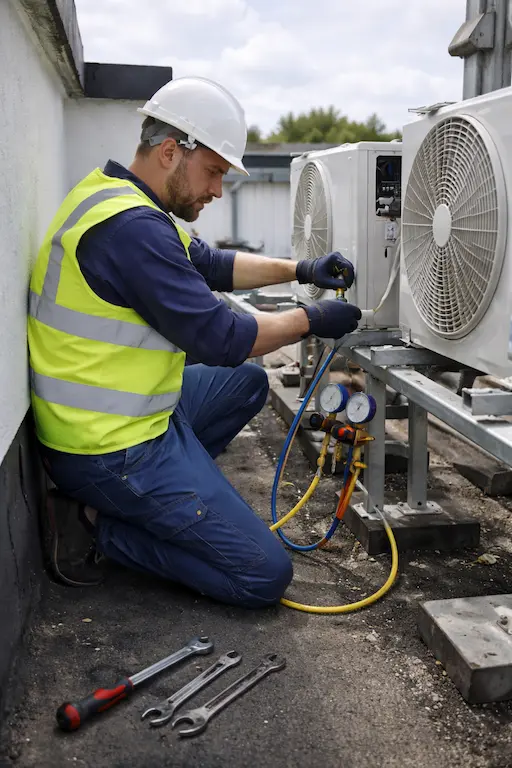
The Pacific Northwest spent decades assuming it didn’t need commercial air conditioning the way the rest of the country did. That assumption collapsed in the summer of 2021, when a heat dome pushed temperatures past 110 degrees across Western Washington — and buildings without adequate cooling became emergency situations. Since then, facility managers across Thurston, Pierce, and Lewis Counties have been playing catch-up: retrofitting AC into buildings that were never designed for it, upgrading undersized equipment, and building service agreements for cooling systems that previously sat idle for eleven months a year. Elite Mechanical Services provides commercial AC inspection, diagnostic, refrigerant service, repair, and maintenance for facilities throughout Lacey, Olympia, Tumwater, and Western Washington — whether your system runs year-round or wakes up in May and has to perform immediately.
Commercial AC in the Pacific Northwest presents specific service challenges that contractors from other regions don’t always recognize. The marine climate creates persistent moisture conditions that accelerate condenser coil corrosion. Short, intense cooling seasons mean equipment goes months without running — and the first hot day of the year is when deferred maintenance shows itself. Buildings designed for the historic Pacific Northwest climate weren’t built with the electrical infrastructure or duct capacity to handle the cooling loads that current summer temperatures are generating. Our EPA Section 608 certified technicians and Mitsubishi Diamond Contractor status put Elite in a position to handle the full range of commercial AC work — from refrigerant recovery and recharging to Mitsubishi VRF cooling system service — under GC License ELITEMS796R2 across the full Western Washington service footprint.
Contact Us Now At (360) 489-0717
Commercial Mechanical Contractor | Lacey, WA | Founded 2021
Why Commercial Property Owners Trust Elite for AC Services
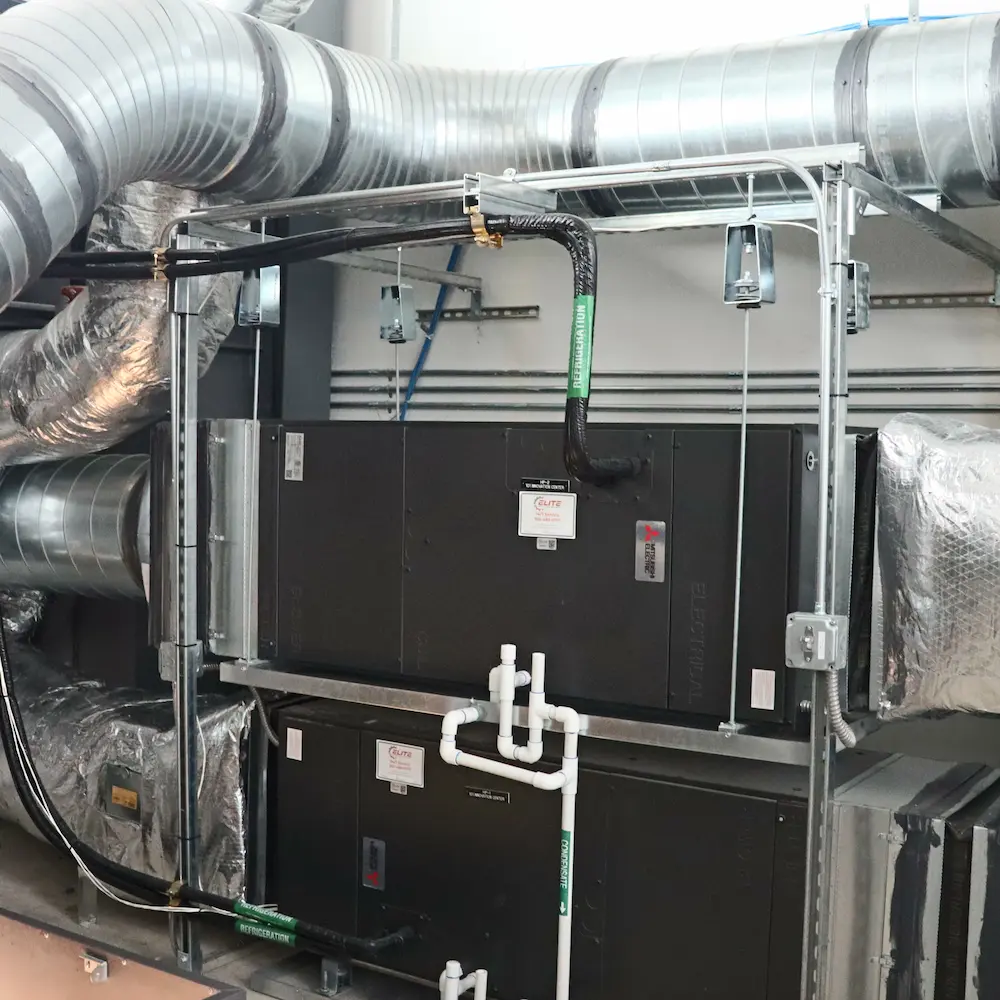
EPA-certified on refrigerants. Factory-trained on Mitsubishi. Tuned to the Pacific Northwest's cooling demands.
Commercial AC service in the South Sound has a specific problem that doesn't exist in markets with longer cooling seasons: nobody notices the issues until the first heat event of summer, and by then the technician shortage is real and scheduling is weeks out. A system that sat idle from October through April often has refrigerant that shifted during temperature cycling, coils that picked up a season's worth of airborne debris, and a capacitor that was borderline last fall and has now crossed the line. Facilities that proactively service their AC before cooling season starts get ahead of that crunch. Facilities that don't call until it's 95 degrees wait.
Scheduling AC service in spring — not July — is the single most effective thing a South Sound facility manager can do to guarantee cooling reliability when the heat arrives.
Elite's EPA Section 608 certified technicians are legally authorized and technically trained for all commercial AC refrigerant work — recovery, charging, leak testing, and the documentation requirements that federal law mandates for each. This matters specifically because commercial AC systems hold significantly more refrigerant than residential equipment, and improper handling creates both compliance exposure and environmental liability. As a Mitsubishi Diamond Contractor, Elite holds factory-endorsed service capability on Mitsubishi's commercial cooling product line — including the VRF systems that have become the dominant choice for multi-zone commercial cooling retrofits in South Sound office buildings and schools over the past decade.
Elite holds MWBE Cert #M1F0027854, DBE Cert #D1F0027854, and PWSBE Cert #P000027854. These certifications are particularly relevant for publicly funded AC retrofit and installation projects — school district cooling upgrades, tribal gaming and hospitality facilities, public health clinic additions, and municipal building retrofit projects where procurement regulations require or score certified minority and disadvantaged business contractors. If your project is subject to those requirements, Elite qualifies and has the mechanical credentials to match.
We provide commercial AC services for data centers and server rooms, healthcare clinics and medical offices, restaurants and commercial kitchens, retail centers, schools, government buildings, tribal facilities, hotels, and office buildings throughout Thurston, Pierce, Lewis, Cowlitz, Mason, and Grays Harbor Counties — any commercial facility where a cooling failure creates immediate operational, safety, or compliance risk.
See Our Full Range of Commercial Mechanical Services
AC is one side of your building’s year-round mechanical equation. The same equipment that cools in summer often provides heating in winter — and the same contractor who services it in July should be the one running your winter maintenance program. Elite covers the complete mechanical scope for commercial facilities across Western Washington: HVAC service, installation, boiler maintenance, building automation, commercial plumbing, and refrigeration — under one contract, one point of contact, one service record.
Commercial AC in the Pacific Northwest — What Makes It Different Here
Commercial AC service covers the inspection, diagnostic testing, refrigerant recovery and recharging, coil cleaning, electrical component testing, and controls verification of cooling equipment in commercial buildings. In the Pacific Northwest, commercial AC service carries regional context that facility managers elsewhere don’t face: equipment that sits idle for six or more months each year, buildings with inadequate insulation and duct capacity for cooling loads, and a marine climate that corrodes condenser coils and coil fins faster than inland climates do.
When commercial AC equipment goes dormant for the winter — which most South Sound systems do — several failure modes develop quietly. Refrigerant migrates within the system during temperature cycling and may be unevenly distributed when the compressor starts in spring. Capacitors that were borderline at the end of last cooling season fail during startup. Condenser coils accumulate moss, lichen, and airborne debris from the wet Pacific Northwest environment at rates that inland climates don’t produce. Economizer dampers corrode or seize in the closed position, blocking free cooling. None of these conditions produce a service call during the off-season — they all show up as a failure on the first hot day, when scheduling a technician is hardest.
Commercial AC equipment sold and installed in the United States is rated under standards developed by AHRI — the Air-Conditioning, Heating, and Refrigeration Institute — which certifies equipment performance at defined test conditions. The AHRI ratings published for any piece of commercial AC equipment (cooling capacity in BTU/hr or tons, EER, SEER2) represent performance at standard test conditions, not necessarily your building’s actual load conditions. In Pacific Northwest facilities with high latent loads — commercial kitchens, indoor pools, healthcare spaces — actual cooling performance may differ from AHRI-rated capacity, and equipment selection that ignores latent load requirements leads to humidity problems even when the equipment is running correctly. Full details on AHRI equipment certification and performance ratings are available at ahrinet.org.

Schedule a commercial AC service call if any of these conditions describe your facility: your cooling equipment has not been serviced since last cooling season or longer; you noticed comfort complaints, high humidity, or inconsistent zone temperatures during last summer’s heat events; your refrigerant type is R-410A and your equipment is more than eight years old; or your cooling system serves spaces with high heat loads — server rooms, commercial kitchens, dense occupancy — where failure is not just uncomfortable but operationally disruptive. For many South Sound commercial buildings that added or upgraded AC after 2021, the original installation hasn’t had its first professional service visit.
Why facility managers choose us
Our Commercial AC Service Process
Our approach to commercial AC service starts with identifying what the system is actually doing — not assuming it’s working because it turned on. Pacific Northwest equipment that has been dormant for months needs a proper startup inspection before the cooling season, not just a power cycle. Here’s how we run a commercial AC service call:
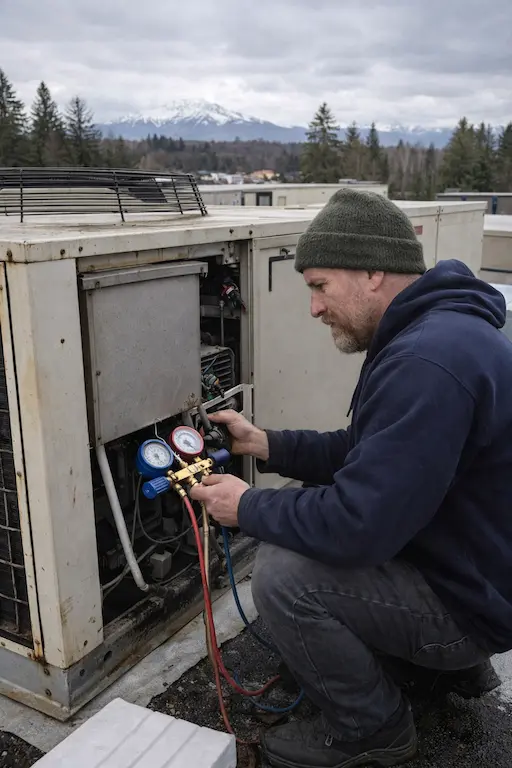

Cooling system inspection and startup assessment
We inspect all major AC components before startup — condenser coils, evaporator coils, electrical connections, capacitors, contactors, fan motors, refrigerant service valves, and controls. For systems that have been dormant over winter, we check for signs of refrigerant migration, coil fouling, and rodent or debris intrusion before starting the compressor. This pre-startup check prevents the compressor from starting against conditions that cause damage.

Refrigerant identification and charge verification
We identify the refrigerant type in the system — R-410A, R-32, R-454B, or legacy refrigerants on older equipment — and verify the charge against manufacturer specification using temperature/pressure measurements at actual operating conditions. An undercharged system reduces cooling capacity and risks evaporator icing. An overcharged system raises discharge pressure and stresses the compressor. Neither condition is visible without measurement, and both are common on equipment that hasn't been professionally serviced.

Coil cleaning and airflow service
Both condenser and evaporator coils are cleaned to manufacturer standards. In Pacific Northwest environments, condenser coils accumulate organic debris — moss spores, pollen, lichen — that impairs heat rejection and accelerates fin corrosion at rates that contractors in drier climates don't typically plan for. Evaporator coils collect dust and biofilm that reduce airflow and cooling capacity. Clean coils are the single most impactful maintenance task for AC efficiency and longevity.

Electrical component testing and replacement
We test capacitors, contactors, fan motors, and control boards under operating conditions. Capacitors are the most common single-component failure on commercial AC equipment, and a borderline capacitor that survives spring startup often fails in July when ambient temperatures are highest and compressor starts are most frequent. We document capacitor measurements and recommend replacement when readings fall outside acceptable range — before the failure, not after.

Performance verification under cooling load
With the system running under cooling load, we verify supply air temperature drop across the evaporator, suction line temperature and superheat, condenser leaving air temperature, and system pressures against the manufacturer's performance data for actual ambient conditions. This tells us whether the system is achieving its rated cooling capacity — not just whether it's running.

Seasonal program enrollment or follow-up scheduling
We close every AC service call with a clear status summary and a recommendation for follow-up frequency. For equipment that passed inspection with no significant findings, we recommend annual spring startup service. For equipment with developing issues, we schedule a fall shutdown inspection before the system goes dormant again. For facilities with multiple cooling systems, we discuss a consolidated seasonal AC service agreement that covers all units under one annual visit schedule.
Commercial Mechanical Contractor | Lacey, WA | Founded 2021
Commercial Cooling Equipment and Refrigerant Services
Commercial AC service isn’t one thing — it varies significantly by equipment type, refrigerant, controls configuration, and building use. Here’s what Elite services across the range of commercial cooling equipment found in South Sound facilities:
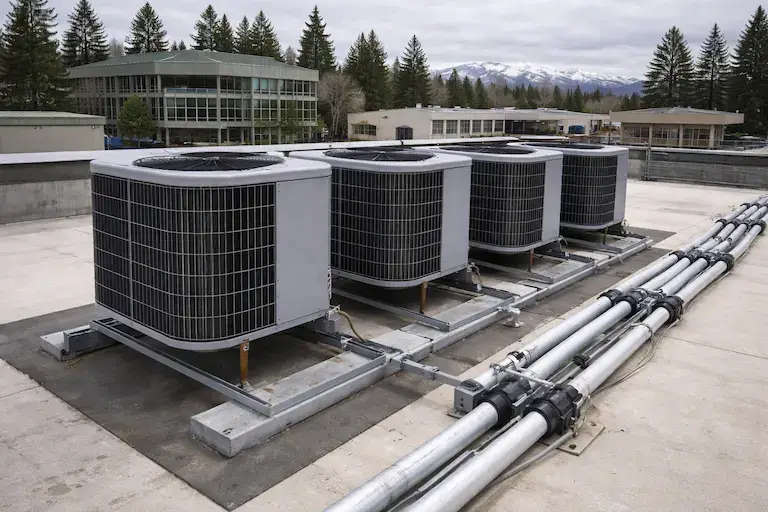
Rooftop AC and Packaged Cooling Units
Rooftop package units with cooling-only or heat pump configurations are the most common commercial AC source in the South Sound's low-rise commercial inventory. Their rooftop location subjects them to the full Pacific Northwest marine environment — persistent moisture, seasonal organic debris, salt-laden air in coastal Grays Harbor and Mason County markets, and the freeze-thaw cycles that stress electrical connections and refrigerant lines. Elite provides comprehensive rooftop AC service including condenser coil cleaning and fin straightening, refrigerant charge verification, economizer inspection and adjustment, cooling controls calibration, and full-system startup verification before each cooling season begins. For facilities where rooftop AC equipment is approaching the end of its serviceable life — typically 15 years for most commercial RTUs — we provide a documented condition assessment that gives the building owner clear information for capital planning decisions. Replacing aging R-410A equipment on a planned schedule costs significantly less than emergency replacement during peak cooling demand.
VRF and Mini-Split Cooling Systems
Variable refrigerant flow systems and commercial mini-splits have become the dominant choice for South Sound AC retrofits over the past decade — particularly for school buildings, medical offices, and multi-tenant commercial spaces that lack the ductwork for a central cooling system. Their efficiency in cooling mode comes from variable-speed compressor technology that modulates output based on actual demand, avoiding the short-cycling that reduces both efficiency and equipment life in conventional single-speed equipment. As a Mitsubishi Diamond Contractor, Elite services Mitsubishi's commercial VRF/VRV product line — including City Multi systems in cooling-only and heat recovery configurations. In cooling mode, heat recovery VRF systems require specific attention to refrigerant distribution across the branch circuit controllers — an area where non-certified technicians frequently cause problems by applying split-system diagnostic approaches to multi-pipe VRF systems. Our Diamond certification means our technicians are trained on VRF-specific diagnostics, not general HVAC approaches applied to a different system architecture.
Chilled Water Fan Coil Systems
Larger commercial and institutional buildings — hospitals, multi-story office buildings, educational complexes — often use chilled water systems where a central chiller produces chilled water that circulates through insulated piping to fan coil units throughout the building. Fan coils provide zone-level cooling without refrigerant lines running to every space, which simplifies maintenance and reduces refrigerant volume significantly. Elite services the fan coil and distribution side of chilled water AC systems — coil cleaning, valve and actuator service, controls calibration, condensate pan and drain service, and filter management. For the central chiller plant itself, see our Chiller and Cooling Tower Services page. The combination of chiller plant service and fan coil service under one contractor eliminates the finger-pointing between trades that complicates troubleshooting in chilled water systems.
Refrigerant Recovery, Charging, and Leak Testing
All refrigerant work on commercial AC equipment — recovery before any repair that opens the refrigerant circuit, charging after repair or seasonal verification, and leak testing on systems with suspected losses — is federally regulated under EPA Section 608. Elite's EPA 608 certified technicians handle all refrigerant work in full compliance with current regulations. This includes using the correct A2L refrigerant (R-454B or R-32) for new equipment manufactured after January 2025, and using recovered or reclaimed R-410A for existing systems that still use that refrigerant. We document all refrigerant quantities — recovered, recharged, and any losses — as required by EPA reporting requirements for commercial systems. AHRI's equipment certification database at ahrinet.org provides verified performance data for most commercial AC equipment, including rated refrigerant charge weights that we use as the baseline for charge verification on all equipment where manufacturer data is unavailable at the service site.
Seasonal AC Startup and Shutdown Programs
The Pacific Northwest's distinct cooling season creates a specific service need that doesn't exist in markets where AC runs year-round: deliberate, professional seasonal transitions. A spring AC startup program covers everything the system needs before it runs under load for the first time each year — coil cleaning, refrigerant verification, electrical component testing, and controls calibration. A fall shutdown program documents the system's condition at the end of the cooling season — identifying anything that needs attention over winter before it becomes a spring emergency — and winterizes condensate lines and outdoor components where applicable. Elite offers seasonal startup and shutdown programs for commercial AC clients throughout the South Sound, available on annual contracts that cover a spring visit and a fall visit for each piece of equipment in the facility. For clients with multiple AC systems or multiple buildings, we coordinate all seasonal visits under a single program schedule.
One Contractor. Every System. The Whole Region.
Don’t wait until July to schedule your commercial AC service. Contact Elite Mechanical Services at (360) 489-0717 or fill out our contact form to book a spring startup inspection. We serve commercial facilities across Lacey, Olympia, Tumwater, Tacoma, and Western Washington.
Commercial AC Projects Across the South Sound
Grays Harbor and the Coastal Market
Commercial facilities in Aberdeen and Hoquiam operate in a coastal marine environment that creates AC service demands different from the inland South Sound market. Salt-laden air off the Pacific accelerates condenser coil corrosion and fin deterioration at rates that require more frequent coil service than facilities in Lacey or Olympia typically need. Commercial buildings in the Aberdeen and Hoquiam market — retail, healthcare, hospitality, and light industrial — often have older AC equipment that predates the current awareness of Pacific Northwest cooling needs and carries deferred maintenance from years when the equipment rarely ran under significant load. Elite serves the Grays Harbor coastal market with the same permitting standards, documentation, and refrigerant compliance we apply everywhere — and with specific attention to the coil protection and fin treatment approaches that coastal environments require.
Tacoma and Pierce County Healthcare and Hospitality
The commercial AC service demand in Pierce County — anchored by Tacoma’s healthcare campuses, hospitality corridor, and dense commercial office market — is driven by facility types where cooling is not seasonal but continuous. Hospital buildings, hotel towers, and dense office campuses in Tacoma, Lakewood, University Place, and Puyallup run cooling systems year-round, which changes both the service frequency and the failure mode profile. Year-round systems accumulate coil fouling and refrigerant losses at a pace that seasonal systems don’t, and their operators have less tolerance for the kind of capacity creep that goes unnoticed in equipment that only runs in summer. Elite provides commercial AC service for Pierce County’s continuous-operation facilities with service schedules tuned to year-round system demands rather than the seasonal startup/shutdown model appropriate for much of the South Sound’s commercial building stock.
Thurston County Schools and Government Buildings
The post-2021 commercial AC retrofit wave in Thurston County has been most visible in the public school system — buildings designed in an era when cooling was considered unnecessary in Western Washington that are now being retrofitted with ductless mini-split systems, through-wall units, and portable cooling supplemented by VRF systems in facilities where full-building cooling is warranted. These retrofit systems are often maintained by facilities departments that received the equipment without a service program in place. Elite provides commercial AC service for Thurston County public school facilities, government buildings, and the county’s growing commercial corridor along the Hawks Prairie and Lacey-Olympia I-5 frontage — and we understand the public procurement documentation and supplier diversity requirements that most school and government AC service contracts involve.
- Data centers and server rooms requiring continuous precision cooling
- Hospitals, clinics, and healthcare facilities where cooling failure is a patient safety issue
- Commercial kitchens and restaurants — high internal heat loads year-round
- Retail centers and grocery stores where AC failure affects inventory and customer traffic
- Hotels and hospitality properties running cooling systems continuously
- Office buildings and corporate campuses with dense occupancy heat loads
- School districts with post-2021 AC retrofits that need their first professional service
- Government and tribal facilities managing publicly funded cooling equipment
- Warehouses and light industrial spaces with process heat that requires mechanical cooling
- Multi-tenant buildings where landlord AC service affects tenant lease compliance
Who Calls Elite for Commercial AC Service
The range of commercial facilities that depend on reliable cooling in the South Sound spans every industry — from data centers where a three-degree temperature rise triggers equipment shutdown to school buildings that were retrofitted with AC after the 2021 heat dome and haven’t had professional service since installation. What these facilities share is that cooling failure carries an immediate cost: operational disruption, safety exposure, lease liability, or equipment loss.
We handle commercial AC service only — no residential window units, no home AC calls. That commercial focus means our scheduling, documentation standards, refrigerant compliance procedures, and service expectations are calibrated to building professionals, facility managers, and procurement officers — not homeowners.
Commercial AC Service Across Six Western Washington Counties
Coastal to Core
Elite Mechanical Services covers commercial AC service across six counties in Western Washington, from the Grays Harbor coast through Mason County, across Thurston and Pierce Counties, and south through Lewis and Cowlitz Counties along the I-5 corridor. Our Lacey, WA headquarters puts us at the center of the Thurston County commercial AC market — schools, government buildings, medical offices, and the growing commercial corridor along Hawks Prairie — but our service footprint extends well beyond the South Sound core.
I-5 Corridor and Southern Counties
Lewis County’s commercial AC market in Centralia and Chehalis includes a mix of retail, hospitality, healthcare, and light industrial facilities that typically have less access to commercial-grade HVAC service than the Thurston and Pierce County markets. Many of these facilities operate aging AC equipment without active service agreements. Cowlitz County’s Longview and Kelso commercial market — anchored by the industrial and port-adjacent commercial base on the Columbia River — has similar characteristics, with commercial AC equipment that rarely gets professional attention until a failure forces the issue.
Multi-Site and Portfolio Clients
For organizations managing AC equipment across multiple buildings in this footprint — school districts, tribal enterprises, regional healthcare networks, commercial property management companies — Elite structures seasonal AC service agreements that cover all facilities under one coordinated schedule. Spring startup across all sites happens on a planned timeline, not a reactive one. Service records for each building feed into a unified documentation system. And when a pattern shows up — capacitor failures at a specific age across a fleet of similar units — the whole portfolio benefits from the finding, not just the one building where it failed first.
Review our complete service area across Western Washington to confirm your facility’s location, or call (360) 489-0717 to discuss your building’s cooling service needs directly.
Why Choose Elite for Commercial AC Service
Pacific Northwest commercial AC is a discipline where local climate knowledge matters as much as mechanical credentials. A contractor who services commercial AC in Phoenix or Atlanta hasn’t dealt with marine coil corrosion, moss-fouled condenser fins, or the specific failure patterns that emerge when equipment runs hard for six weeks a year in a persistently damp coastal environment. Elite’s commercial AC work is grounded in the South Sound’s actual climate — and backed by the refrigerant compliance credentials that federal law requires on every service call.
- EPA Section 608 certified technicians — all refrigerant recovery, charging, and leak testing legally compliant
- Mitsubishi Diamond Contractor — factory-certified on commercial VRF/VRV cooling systems
- GC License: ELITEMS796R2 | Electrical License: ELITEMS787CH
- Union contractor — union-trained technicians on every commercial AC service call
- Tridium Niagara | JCI Facility Explorer | ABB Cylon BACnet — controls integration for AC systems
- Seattle Grade III Boiler Supervisor | Boiler License #LIC-BO-1670 — year-round mechanical coverage
- MWBE Cert #M1F0027854 | DBE Cert #D1F0027854 | PWSBE Cert #P000027854
- Bond capacity: $750,000 single project | $1.2 million aggregate
- Founded 2021 | Minority-owned, woman-owned, Indigenous-owned, Latino-owned
Commercial AC service in the South Sound has a seasonal clock on it. The window between when a facility manager schedules service and when the equipment needs to perform runs roughly from March through May. Miss that window, and the choices are waiting in a queue with everyone else who deferred service, or paying emergency rates for a technician who may not be familiar with your specific equipment. Elite’s commercial AC clients don’t make that call in July because their service agreements don’t let them forget about it in March.
Does Elite service commercial AC equipment from all manufacturers?
Yes. Elite Mechanical Services services commercial AC equipment from all major manufacturers — including Mitsubishi, Carrier, Trane, Daikin, Lennox, York, and others — across rooftop package units, split systems, VRF/VRV multi-zone systems, and ductless mini-splits. Our Mitsubishi Diamond Contractor status gives us factory-endorsed service capability on Mitsubishi's commercial product line, including the specific diagnostic and commissioning tools that VRF systems require. For equipment from other manufacturers, we work from the manufacturer's service documentation and performance data, not from general estimations.
Does Elite offer seasonal AC startup and shutdown service programs?
Yes. Elite offers seasonal commercial AC programs covering spring startup inspections before cooling season and fall shutdown inspections at the end of it. Spring startup covers coil cleaning, refrigerant charge verification, electrical component testing (with specific attention to capacitors and contactors), controls calibration, and full performance verification under cooling load. Fall shutdown documents system condition at season end and identifies any items that need attention before the system starts again the following spring. Seasonal programs are available on annual contracts for single buildings or consolidated across multiple facilities for clients managing several sites.
Are there Washington state requirements for refrigerant handling on commercial AC systems?
Yes, at both the federal and state level. Federally, EPA Section 608 governs all commercial refrigerant handling — recovery, charging, leak inspection, and documentation. Washington state has also adopted the EPA’s A2L refrigerant restrictions under the AIM Act, meaning new commercial AC equipment installed in Washington must use lower-GWP refrigerants (R-454B, R-32) rather than R-410A, which is no longer permitted in newly manufactured equipment. Separately, Washington’s Department of Ecology regulates refrigerant emissions as part of the state’s climate commitment, and facilities subject to Washington’s Climate Commitment Act may have additional refrigerant reporting obligations. Elite’s EPA 608 certified technicians handle all refrigerant work in compliance with both federal EPA requirements and Washington state regulations. Information on Washington’s environmental refrigerant requirements is available from the Washington State Department of Ecology at ecology.wa.gov.
What does EPA Section 608 certification actually require for commercial AC service?
EPA Section 608 requires that any technician who opens a commercial refrigerant circuit — for repair, replacement, or inspection — must hold a valid Section 608 certification and use certified recovery equipment before venting or releasing refrigerant. It also establishes leak inspection requirements for commercial systems above certain refrigerant charge thresholds, and requires documentation of refrigerant quantities for systems over 50 pounds of charge. For commercial AC equipment, which routinely holds quantities well above that threshold, these aren't paperwork formalities — they're federal law with civil penalty exposure for violations. Every Elite technician who works on commercial AC refrigerant is EPA Section 608 certified, and we document all refrigerant handling on every service call.
Can Elite service the Mitsubishi mini-split and VRF systems installed in commercial buildings after the 2021 heat dome?
Yes. As a Mitsubishi Diamond Contractor, Elite Mechanical Services services Mitsubishi ductless and VRF equipment in commercial buildings across the South Sound, including systems added after 2021 that have never had a service program. Elite brings deferred maintenance current and can enroll the equipment in a seasonal service agreement. If your building received Mitsubishi equipment as part of a school district or government retrofit program and has never had professional service, call (360) 489-0717.
Commercial Mechanical Contractor | Lacey, WA | Founded 2021
Frequently Asked Questions
Commercial Cooling That Holds Up When the Heat Arrives
Elite Mechanical Services provides commercial AC service, repair, refrigerant service, and seasonal maintenance programs for facilities across Lacey, Olympia, Tumwater, Tacoma, and Western Washington. Spring startup. Fall shutdown. Emergency diagnostics. EPA-compliant refrigerant handling. One contractor for all of it. Call (360) 489-0717, email admin@elitemechsvcs.com, or fill out our online quote request form.