Commercial Boiler Maintenance in Lacey, WA
There’s a distinction that matters in commercial boiler maintenance that most building owners don’t fully understand: the difference between an L&I inspection and a contractor maintenance visit. Washington state’s boiler inspection program under WAC 296-104 requires that regulated commercial boilers receive periodic inspections by an L&I-commissioned inspector — but that inspection confirms code compliance, not operational performance. The L&I inspector verifies that your boiler is legally operating. They don’t tune the burner, check combustion efficiency, inspect the heat exchanger for scaling, or verify that safety controls are calibrated correctly. That work falls to your mechanical contractor. Elite Mechanical Services provides commercial boiler maintenance programs for facilities across Lacey, Olympia, Tumwater, and Western Washington — the service work that keeps boilers running efficiently and safely between L&I inspections, and that prepares them to pass those inspections when they’re due.
Our boiler maintenance programs are built around Elite’s Grade III Boiler Supervisor credential (Boiler License #LIC-BO-1670) — the credential tier that Washington state and the City of Seattle recognize for commercial boiler work. We document every maintenance visit with detailed service records that support both your operational records and your L&I inspection file. For facilities operating under public procurement frameworks — school districts, tribal organizations, government agencies — our MWBE, DBE, and PWSBE certifications mean Elite qualifies for the supplier diversity requirements that frequently apply to institutional service contracts. All boiler maintenance work is performed by union-trained technicians under GC License ELITEMS796R2 and Electrical License ELITEMS787CH.
Contact Elite Mechanical Services at (360) 489-0717
Commercial Mechanical Contractor | Lacey, WA | Founded 2021
The Standard Elite Brings to Commercial Boiler Maintenance
Grade III Boiler Supervisor. Combustion-tested. Documented for L&I readiness. Every visit.
The commercial boiler maintenance market in the South Sound has a specific failure pattern: facilities that pass L&I inspection but run their boilers at poor combustion efficiency because nobody has tuned the burner in three years. A boiler can carry a current Certificate of Inspection and still be running 15 to 20 percent below its rated thermal efficiency because of heat exchanger scaling, combustion air drift, or a burner that's been operating on the wrong fuel-to-air ratio since the last service call. The L&I Certificate tells you the boiler is legally operable. It says nothing about whether it's running well. Most commercial boiler failures — heat exchanger cracks, waterside corrosion, safety control malfunctions — don't announce themselves on an L&I inspection form. They show up on a maintenance visit that catches them before they become a shutdown or a safety event.
Passing L&I inspection and running a properly maintained boiler are not the same thing. Elite provides the maintenance that bridges that gap.
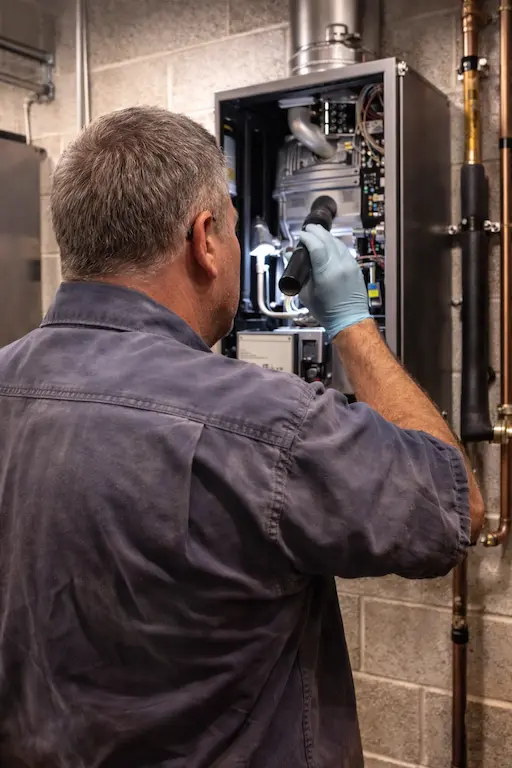
Elite's Grade III Boiler Supervisor credential is the classification that Washington state and the City of Seattle require for commercial boiler supervision — covering boiler theory, ASME Boiler and Pressure Vessel Code, safety control systems, combustion analysis, and emergency procedure knowledge. Our technicians bring that credential to every maintenance visit. We perform combustion analysis with calibrated instruments, document measured stack temperature, CO, CO2, O2, and excess air percentage, and adjust burner settings when readings fall outside manufacturer specifications. These aren't visual checks — they're measured readings against documented targets.
Institutional facilities with ongoing boiler service requirements — school districts operating aging boiler plants, tribal gaming and hospitality operations, public health and social service facilities, municipal buildings — frequently carry procurement requirements that score or require certified minority and disadvantaged business contractors for service agreements. Elite's MWBE (Cert #M1F0027854), DBE (Cert #D1F0027854), and PWSBE (Cert #P000027854) certifications make us a qualified vendor under those frameworks, without compromising on the technical credentials that commercial boiler maintenance demands.
Our boiler maintenance clients include schools, hospitals, government buildings, tribal facilities, hotels, multi-unit residential buildings, and industrial facilities with process heating throughout Thurston, Pierce, Lewis, Cowlitz, Mason, and Grays Harbor Counties — any commercial or institutional facility where a boiler is the primary heating source and where consistent, documented maintenance is part of managing both operational risk and regulatory compliance.
Boiler Maintenance as Part of Your Complete Mechanical Program
A boiler maintenance program doesn’t operate in isolation from the rest of a building’s mechanical infrastructure. The hydronic distribution system, the BAS controls managing setpoints and schedules, and the plumbing connections serving domestic hot water all affect how the boiler performs — and all benefit from the same contractor understanding the full system. Elite’s boiler maintenance programs can be integrated with HVAC service, building automation calibration, and commercial plumbing maintenance under a single service agreement. One service schedule, one point of contact, one documentation system for your entire mechanical scope.
What Commercial Boiler Maintenance Actually Covers — and Why It Matters
Commercial boiler maintenance covers combustion analysis and burner adjustment, heat exchanger inspection and cleaning, safety control testing (low-water cutoff, high-limit, pressure relief valve), waterside inspection and treatment verification, flue and venting inspection, operating controls calibration, and documentation of all findings and adjustments. It is distinct from the L&I inspection, which is a regulatory compliance review — maintenance is the operational service work that determines whether the boiler runs safely, efficiently, and without developing conditions that lead to failure.
Commercial boilers that operate without regular maintenance develop predictable failure patterns. Heat exchangers accumulate scale from dissolved minerals in the water supply, reducing heat transfer efficiency and creating hot spots that stress the metal. Burners drift from their original combustion settings as components wear, producing either incomplete combustion — with CO risk and efficiency loss — or excessive air, which reduces heating capacity and raises fuel costs. Safety controls — low-water cutoffs in particular — require periodic testing to confirm they actually function; a low-water cutoff that fails to trip during a low-water condition is a hazard, not a safety device. None of these conditions show up on an annual L&I inspection unless they’ve already reached the point of visible defect.
The National Board Inspection Code (NBIC), published by the National Board of Boiler and Pressure Vessel Inspectors and first issued in 1946, is the internationally recognized standard for the installation, inspection, and in-service maintenance of boilers and pressure vessels. Most US and Canadian jurisdictions — including Washington state under WAC 296-104 — reference the NBIC as the basis for their boiler inspection and maintenance requirements. The NBIC’s inspection guidance describes what should be evaluated during an in-service inspection and what constitutes adequate documentation of a boiler’s condition. Full details on the NBIC and its application to commercial boiler maintenance are available at nationalboard.org.
Your facility needs a commercial boiler maintenance program if any of the following are true: your boiler has not had a combustion analysis performed in the past 12 months; your safety controls have not been tested and documented within the past year; you have no service records that document what was found and adjusted at the last maintenance visit; your boiler is approaching or has passed its L&I inspection renewal date and has not had pre-inspection preparation; or your facility has had one or more boiler-related issues — unusual fuel consumption, comfort complaints, or error lockouts — that were reset without a diagnosis. For most commercial buildings in Western Washington with boilers more than five years old, at least two of these apply.

Our Commercial Boiler Maintenance Process
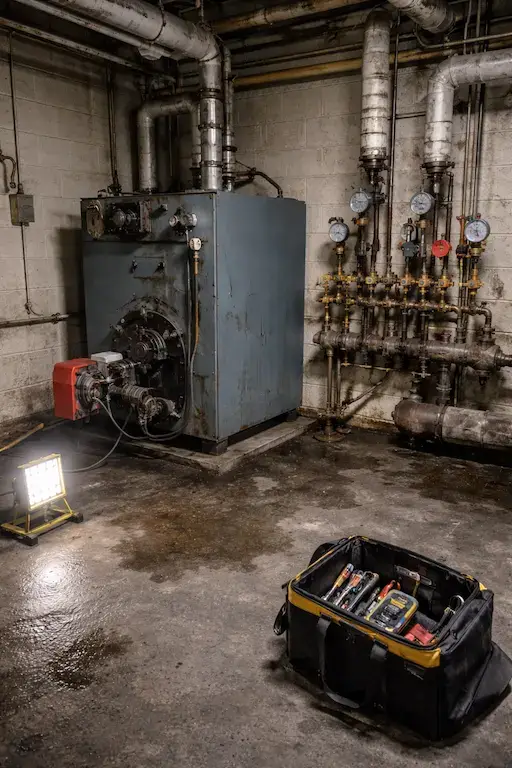
Every Elite boiler maintenance visit follows a documented scope — not a visual walkthrough. We measure what needs to be measured, test what needs to be tested, and record what we find. Here’s what a standard commercial boiler maintenance visit covers from arrival to documentation:
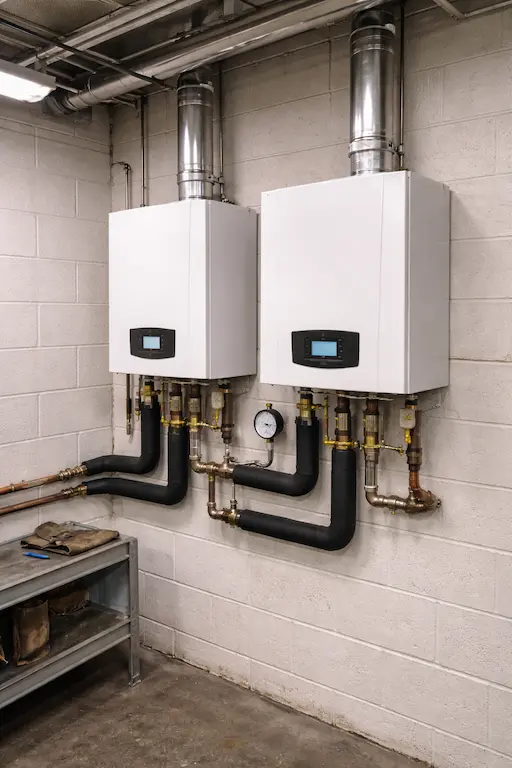

Pre-service inspection and operating condition review
Before we open anything, we review the boiler's operating history — error codes, lockout log, any service records from previous visits — and observe the system operating under load. How is the boiler cycling? Is it hitting setpoint consistently? Are operating pressures and temperatures within the normal range for the system? This pre-service observation catches behavioral issues that component inspection alone doesn't reveal.

Combustion analysis
We connect a calibrated combustion analyzer to the flue and measure stack temperature, carbon monoxide (CO), carbon dioxide (CO2), oxygen (O2), and excess air percentage. These measurements tell us whether the burner is producing complete combustion at the correct fuel-to-air ratio. A CO reading above 100 ppm indicates incomplete combustion and a safety concern. Excess air above the manufacturer's specification means wasted fuel. We document all readings and adjust burner settings when measurements fall outside the manufacturer's specified operating range.

Heat exchanger and combustion chamber inspection
We inspect the heat exchanger surfaces for scale buildup, corrosion, and physical damage. Scale reduces heat transfer and creates differential temperatures that stress exchanger material — a scaled heat exchanger running at 15% scale buildup can lose 10–15% of its rated thermal efficiency. We inspect the combustion chamber refractory and burner assembly for deterioration, carbon deposits, and physical damage that affects combustion quality.

Safety control testing and documentation
We test every required safety control under the conditions it is designed to respond to. The low-water cutoff is tested by dropping water level to confirm it trips correctly. The high-limit control is verified to shut the burner at the correct temperature. Pressure relief valves are inspected for seat condition and corrosion — full test discharge is coordinated with the building owner where applicable, per Washington state requirements. All test results are documented with pass/fail status and the measured trip points.

Waterside inspection and treatment verification
We inspect the waterside of the system — checking for visible corrosion indicators in the water sample, verifying that treatment chemical levels are within the correct range for the system type, and inspecting strainers and air separators for accumulated debris. For systems without a water treatment program in place, we identify this as a finding and document the risk — scaling and corrosion are the leading causes of premature heat exchanger failure in commercial boilers.

Documentation and maintenance record
Every maintenance visit produces a written service record: combustion analysis readings, safety control test results, heat exchanger condition assessment, waterside findings, any adjustments made, and items flagged for follow-up before the next visit or before the next L&I inspection. This record goes to the building owner, not a filing cabinet. For facilities approaching their L&I inspection renewal, we note the items that the L&I inspector will look for and confirm that they've been addressed.
Commercial Mechanical Contractor | Lacey, WA | Founded 2021
Commercial Boiler Maintenance Scope by System Type
Different boiler system types have distinct maintenance requirements driven by their operating principles, safety control configurations, and common failure modes. Here’s what Elite covers for each system type found in Western Washington commercial facilities:
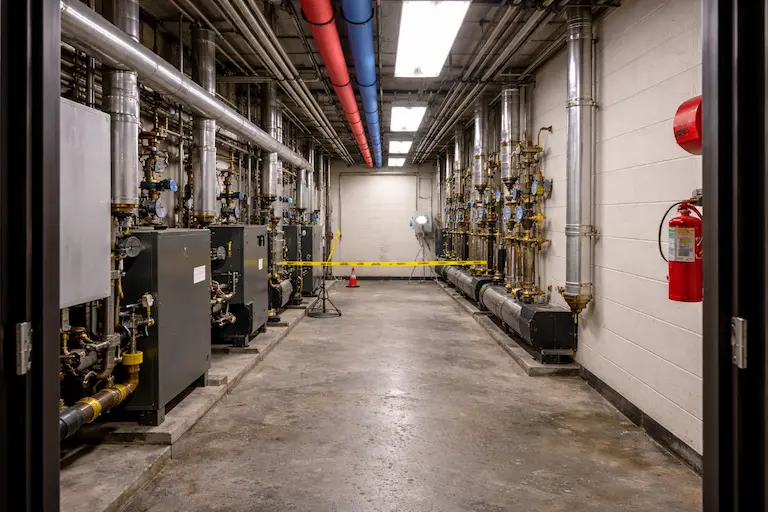
Hot Water Heating Boilers
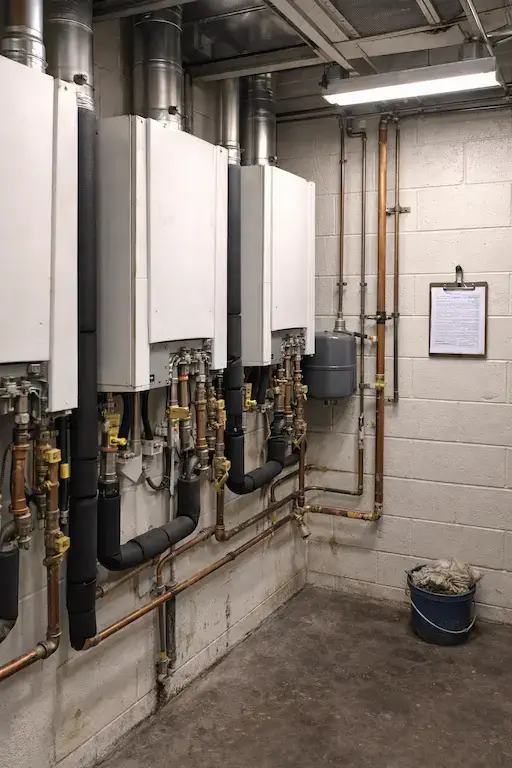
Hot water heating boilers — the most common type in South Sound commercial and institutional buildings — are subject to annual external inspection under WAC 296-104-100, with internal inspections required every four years. Elite's hot water boiler maintenance program covers combustion analysis and adjustment, heat exchanger inspection, burner assembly service (igniter, flame sensor, gas valve), aquastat and high-limit control calibration and testing, low-water cutoff testing and documentation, expansion tank pressure verification, air separator and strainer service, pump operation check, and system water pressure verification. For condensing hot water boilers — which require return water temperatures below 130°F to achieve their rated efficiency — we also verify that the condensate neutralizer is functional and that condensate drainage is unobstructed. A blocked condensate drain on a condensing boiler creates acidic backflow that accelerates heat exchanger deterioration. This is a common maintenance finding on condensing equipment that has not received regular service.
Steam Heating Boilers
Steam boilers carry a more involved maintenance scope than hot water systems because they operate at higher pressures and because their water management requirements are more demanding. Steam system maintenance includes water level gauge glass inspection and cleaning, steam trap inspection and testing, condensate return system verification, safety valve inspection, steam pressure control calibration, and blowdown valve operation. Steam traps are one of the most commonly neglected components in steam heating systems — a failed-open steam trap dumps live steam into the condensate return continuously, wasting energy and creating condensate management problems throughout the building. Under WAC 296-104-100, steam heating boilers are required to have their low-water fuel cutoff inspected internally at minimum every two years. Elite documents this inspection as part of our steam boiler maintenance program and coordinates timing to align with the L&I inspection schedule where possible, reducing disruption from multiple service visits.
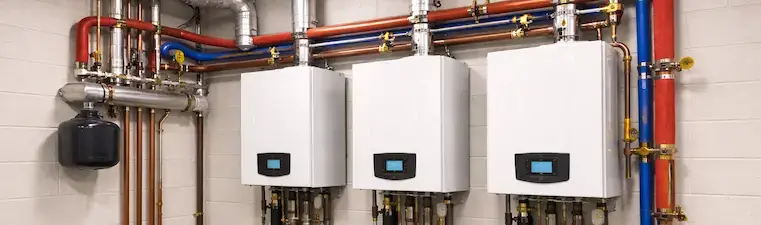
Modular Cascade Systems
Modular cascade boiler systems require maintenance attention at two levels: the individual boiler units and the cascade controller that manages their sequencing. Each unit in a cascade needs the same combustion analysis, heat exchanger inspection, and safety control testing as a standalone boiler. The cascade controller needs to be verified to sequence units correctly — bringing lead and lag units on and off in the right order, maintaining the lead unit rotation to equalize runtime hours across the cascade, and responding to load changes without unnecessary hunting or short-cycling. For facilities that installed modular cascade systems as part of a boiler plant upgrade — replacing a single large boiler with multiple smaller units for redundancy and efficiency — the cascade controller programming should be reviewed annually to confirm that setpoints and staging logic still match the building's actual heating load profile. Load profiles change as buildings are renovated and occupied differently, and cascade controller settings that made sense at commissioning may produce inefficient operation years later.
BAS-Integrated Boiler Systems
Commercial boilers connected to a Tridium Niagara, JCI Facility Explorer, or ABB Cylon BACnet building automation system require maintenance attention at the controls integration level in addition to the mechanical boiler service. We verify that the BAS setpoint commands are reaching the boiler controls correctly, that outdoor reset sequences are functioning as designed, that occupancy schedules are accurate, and that fault alerts generated by the boiler are routing to the correct recipient in the building's alarm management system. A boiler fault that generates an alarm in the BAS but routes to an email address nobody monitors is not a functioning alarm system — it's paperwork that didn't do anything. We review alarm routing configuration as part of every BAS-integrated boiler maintenance visit and flag routing issues before they result in an unattended fault condition during a heating season weekend.
One Contractor. Every System. The Whole Region.
Your boiler’s L&I Certificate doesn’t mean your boiler is running well — it means it passed a compliance check. Contact Elite Mechanical Services at (360) 489-0717 to schedule the maintenance visit that takes care of everything the inspector doesn’t. We serve commercial facilities across Lacey, Olympia, Tumwater, Tacoma, and Western Washington.
Commercial Boiler Maintenance Across Western Washington
Aging Boiler Infrastructure in Public Buildings
Western Washington’s public school buildings, county government facilities, and tribal community centers contain some of the oldest active commercial boiler equipment in the region — cast iron sectional boilers and fire-tube steam systems installed in the 1960s through 1980s that have been operating on minimal maintenance budgets for decades. These systems have current L&I Certificates of Inspection because they’ve passed the regulatory compliance check. Many of them have never had a combustion analysis performed by a contractor with the instruments and credentials to do it correctly. Elite’s boiler maintenance work in the public sector focuses on establishing a documented baseline — measuring what the system is actually doing, identifying the gap between that and manufacturer specifications, and building a maintenance record that serves both operational planning and procurement documentation requirements. Our MWBE, DBE, and PWSBE certifications qualify us for the service contract procurement processes that govern public school and government building maintenance in Washington state.
Healthcare and Continuous-Operation Facilities
Hospitals, outpatient surgery centers, and residential care facilities in the South Sound operate boilers under occupancy conditions where service windows are extremely limited. Maintenance visits must be scheduled around patient care schedules, with minimal tolerance for system downtime and a zero-tolerance standard for any maintenance-induced safety event. Elite schedules boiler maintenance for healthcare facilities in off-peak periods, communicates the planned scope clearly in advance so facilities teams can prepare, and maintains the documentation standards that healthcare facility accreditation processes require. In Pierce and Thurston County’s healthcare corridor — Tacoma’s medical campus, Olympia’s Capital Medical Center area, and the outpatient clinic concentration in Lacey — Elite provides boiler maintenance for facilities where the reliability standard is effectively continuous.
Remote and Tribal Facilities in Lewis, Mason, and Grays Harbor Counties
Commercial boiler maintenance access in Lewis, Mason, and Grays Harbor Counties is genuinely limited compared to the Thurston and Pierce County core market. Many facilities in these communities operate aging boiler equipment without service agreements in place, relying on reactive repair calls rather than scheduled maintenance programs. Tribal facilities in particular — housing authorities, community centers, and tribal enterprise operations — often manage boiler infrastructure with limited in-house mechanical expertise and limited access to qualified outside contractors. Elite actively serves these communities with the same credential standards, documentation practices, and maintenance thoroughness we bring to the South Sound core. A boiler in Shelton or Chehalis deserves the same quality of maintenance service as one in Lacey.
- Public school districts with aging boiler plants under active L&I inspection programs
- Hospitals and healthcare facilities requiring documented maintenance records for accreditation
- Tribal facilities with limited local access to credentialed boiler contractors
- Hotels and multi-unit residential buildings with continuous heating season demands
- Government and municipal buildings transitioning to active maintenance programs
- Industrial facilities with process heating requirements and documented maintenance obligations
- Property management companies consolidating boiler maintenance across multiple buildings
- New boiler installations needing a maintenance agreement from day one
- Facilities with failed L&I inspections needing corrective maintenance and re-inspection support
- Publicly funded facilities requiring MWBE, DBE, or PWSBE certified maintenance contractors
Who Relies on Elite for Commercial Boiler Maintenance
The common thread across Elite’s boiler maintenance clients is accountability — building owners and facility managers who need documentation they can stand behind. A service record that lists combustion analysis readings, safety control test results, and identified findings is documentation. A sticker from a contractor who showed up for 45 minutes isn’t.
We provide commercial boiler maintenance exclusively — no residential furnaces, no home heating service calls. Commercial boiler maintenance operates under a different technical and regulatory standard, and our technicians work to that standard on every visit.
Boiler Maintenance Service Area — Western Washington
Elite Mechanical Services maintains commercial boilers across all six counties in our Western Washington service area — Thurston, Pierce, Lewis, Cowlitz, Mason, and Grays Harbor. For facility managers and property management companies overseeing multiple boiler-heated buildings across this footprint, Elite structures annual maintenance agreements that cover every site under a single contract. Rather than tracking separate service relationships for each building, clients get one service schedule, one documentation system, and one contractor who knows the equipment at every location.
Our Lacey, WA base gives us strong coverage across the Thurston County institutional market — school districts, state agency buildings, county facilities, and the commercial corridor from Tumwater through Lacey and into the Hawks Prairie area. Pierce County boiler maintenance covers Tacoma’s healthcare and commercial campus concentration, the Lakewood and University Place corridor, and the active commercial and institutional market in Puyallup and DuPont. Lewis County boiler maintenance serves the Centralia-Chehalis I-5 corridor and extends into the rural communities that have limited local access to credentialed boiler contractors.
Cowlitz County boiler maintenance in Longview and Kelso primarily serves commercial and light industrial facilities along the Columbia River corridor. Grays Harbor County — Aberdeen and Hoquiam — is a coastal market where boiler equipment tends to be older and less regularly serviced than the Thurston County core. Mason County work, including Shelton and tribal sites connected to the Squaxin Island Tribe, rounds out our service footprint. We bring the same combustion analysis capability, safety control testing standards, and documentation practices to every county in our service area.
Review our complete service area across Western Washington, or call (360) 489-0717 directly to discuss your facility’s location and boiler maintenance needs.
Why Choose Elite for Commercial Boiler Maintenance
A boiler maintenance program is only as good as its documentation. A contractor who shows up, performs a checklist, and leaves without providing a written record of combustion readings, safety control test results, and identified findings hasn’t given you anything you can use — not for operational planning, not for capital budgeting, not for L&I inspection preparation, and not for the insurance claim that might follow a boiler-related incident. Elite’s maintenance visits produce documented records that the building owner receives and keeps. The record isn’t filed at our office — it belongs to you.
- Seattle Grade III Boiler Supervisor | Boiler License #LIC-BO-1670 — the credential Washington state recognizes for commercial boiler supervision and maintenance
- Intellihot IntelliPRO Contractor — certified for Intellihot commercial tankless water heating system maintenance
- Union contractor — union-trained technicians with the combustion analysis and safety control testing skills commercial boiler maintenance requires
- GC License: ELITEMS796R2 | Electrical License: ELITEMS787CH — full maintenance scope in-house
- Tridium Niagara | JCI Facility Explorer | ABB Cylon BACnet — BAS-integrated boiler controls calibration capability
- EPA Section 608 certified technicians — refrigerant handling compliant where applicable
- MWBE Cert #M1F0027854 | DBE Cert #D1F0027854 | PWSBE Cert #P000027854
- Bond capacity: $750,000 single project | $1.2 million aggregate
- Founded 2021 | Minority-owned, woman-owned, Indigenous-owned, Latino-owned
Commercial boiler maintenance is not complicated if it’s done on schedule, documented correctly, and performed by technicians who understand what they’re looking at. It becomes complicated when it’s deferred, underdocumented, or handed to contractors without the credentials to identify what they’re finding. Elite removes all three of those complications for our clients across Western Washington.
How often should commercial boilers be serviced in Washington state?
Commercial boilers in Washington state are subject to periodic L&I inspections under WAC 296-104-100 — hot water heating boilers receive annual external inspections and internal inspections every four years; steam heating boilers require biennial inspection of their low-water fuel cutoff at minimum. These are regulatory compliance inspections, not maintenance service visits. In addition to L&I inspection intervals, Elite recommends annual contractor maintenance visits for all commercial boilers — covering combustion analysis, safety control testing, heat exchanger inspection, and waterside assessment. Boilers in continuous service or serving healthcare and process heating applications may warrant semi-annual visits. The maintenance visit and the L&I inspection serve different purposes and should not be conflated.
Does Elite provide maintenance documentation that supports L&I inspection readiness?
Yes. Every Elite boiler maintenance visit produces a service record that documents combustion analysis readings, safety control test results with measured values, heat exchanger condition, and any items identified as requiring attention before the next L&I inspection. This documentation is yours — it goes in your building's maintenance file. When an L&I inspector reviews your boiler, having a complete maintenance record that shows regular service and documented safety control testing demonstrates that the boiler has been actively maintained, not just operated until inspection time. For facilities where L&I inspections have lapsed or where a previous inspection produced a notice of violation, Elite can provide pre-inspection maintenance to address identified deficiencies before the inspection is rescheduled.
What is the National Board Inspection Code and why does it matter for boiler maintenance?
The National Board Inspection Code (NBIC), published by the National Board of Boiler and Pressure Vessel Inspectors, is the internationally recognized standard governing the installation, inspection, and in-service maintenance of boilers and pressure vessels. First published in 1946, it is adopted into law by most US and Canadian jurisdictions, including Washington state under WAC 296-104. The NBIC’s inspection guidance describes what should be evaluated during an in-service boiler inspection, what constitutes adequate documentation, and how repair and alteration work on boilers should be performed and documented. When Elite’s technicians test safety controls, inspect heat exchangers, and document findings during a maintenance visit, we are working within the framework that the NBIC establishes for in-service inspection of pressure equipment. More information on the NBIC is available at nationalboard.org.
What does a commercial boiler maintenance visit from Elite actually include?
A standard Elite commercial boiler maintenance visit includes: combustion analysis using a calibrated flue gas analyzer (measuring CO, CO2, O2, excess air, and stack temperature); burner adjustment when combustion readings fall outside manufacturer specifications; heat exchanger inspection for scale, corrosion, and physical condition; safety control testing with documented results — low-water cutoff trip verification, high-limit control verification, and pressure relief valve inspection; operating controls calibration; flue and venting inspection; waterside condition assessment and treatment verification; and a written service record with all measured values and findings. We provide this documentation at the close of every visit.
Can Elite maintain boiler systems that are integrated with our building automation system?
Yes. For boilers connected to a Tridium Niagara, JCI Facility Explorer, or ABB Cylon BACnet building automation system, Elite's maintenance visits include a controls integration review — verifying that BAS setpoint commands are reaching the boiler correctly, that outdoor reset sequences are functioning as designed, and that fault alerts are routing to the correct monitoring location. Elite's BAS credentials — Tridium Niagara, JCI Facility Explorer, ABB Cylon BACnet — mean we can work at both the mechanical level and the controls level during the same maintenance visit, without a separate controls contractor.
Commercial Mechanical Contractor | Lacey, WA | Founded 2021
Frequently Asked Questions
Comprehensive Commercial Boiler Maintenance: Scope and Importance
Elite Mechanical Services provides commercial boiler maintenance programs for facilities across Lacey, Olympia, Tumwater, Tacoma, and Western Washington. Annual service. Combustion analysis. Documented safety control testing. L&I inspection readiness. Grade III Boiler Supervisor on every visit. Call (360) 489-0717, email admin@elitemechsvcs.com, or fill out our online quote request form to get started.