
Commercial Chiller & Cooling Tower Services in Lacey, WA
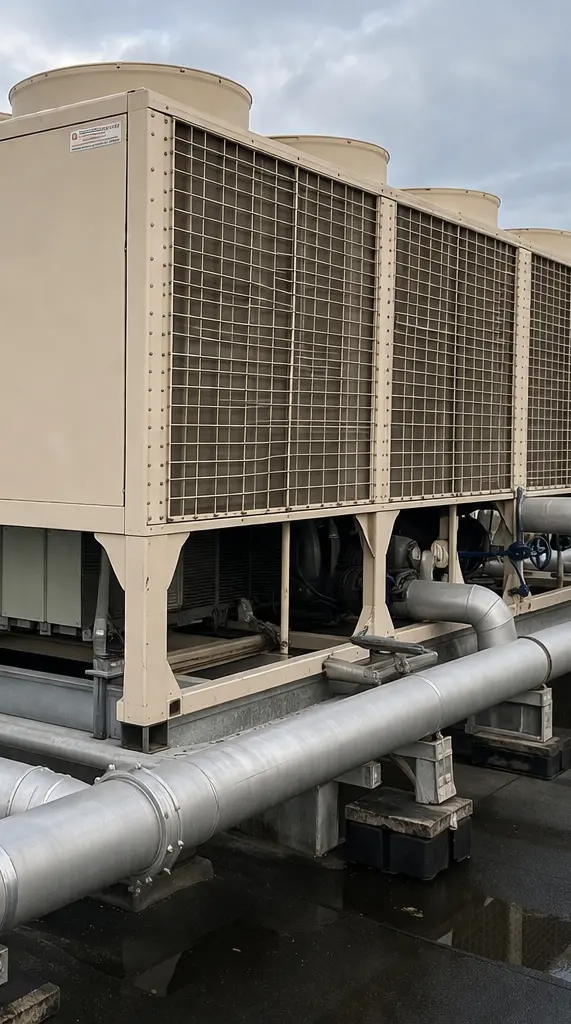
A water-cooled chiller is not a rooftop unit with more tons. It is a central plant system built around two separate water loops — a chilled water loop that circulates cooled water through the building’s air handlers and fan coils to provide cooling, and a condenser water loop that moves heat from the chiller’s condenser to a cooling tower on the roof where that heat is rejected to the atmosphere through evaporation. The efficiency of the chiller — measured in kilowatts per ton of cooling — is directly dependent on the temperature of the condenser water returning from the cooling tower. A poorly maintained cooling tower that returns warm condenser water forces the chiller to work harder, consuming more energy per ton of cooling produced. A cooling tower with biological fouling or scale accumulation on its fill media doesn’t cool the condenser water adequately. A chiller with fouled condenser tubes can’t transfer heat efficiently regardless of how well the cooling tower is performing. These systems are interdependent — and they fail interdependently. Elite Mechanical Services provides commercial chiller and cooling tower installation, maintenance, and water treatment services for facilities across Lacey, Olympia, Tumwater, and Western Washington under our EPA Section 608 certification and GC License ELITEMS796R2.
The refrigerant transition underway in the commercial chiller market adds another layer of complexity that most facility managers haven’t had to navigate before. The EPA’s AIM Act Technology Transitions Program established a 700 GWP limit for new comfort cooling equipment including chillers as of January 1, 2025. The traditional centrifugal and screw chiller refrigerants — R-134a (GWP 1,430) and R-410A (GWP 2,088) — are no longer permitted in new chiller installations. The current generation of chiller equipment uses R-513A (GWP 573), R-1234ze(E) (GWP less than 1), R-1233zd(E) (GWP less than 1), R-515B (GWP 293), and R-32 (GWP 675) depending on compressor type and capacity range. Existing chillers running legacy refrigerants can continue to be serviced — the transition applies to new equipment, not operating systems. But servicing decisions for aging chiller equipment should account for the refrigerant supply and cost trajectory of the phase-down, and replacement planning for systems approaching end of life should specify AIM Act-compliant refrigerant options from the start. Our EPA Section 608 certified technicians handle refrigerant recovery, charging, and leak testing for both legacy and current-generation chiller refrigerants.
Commercial Mechanical Contractor | Lacey, WA | Founded 2021
Elite's Approach to Commercial Chiller and Cooling Tower Service
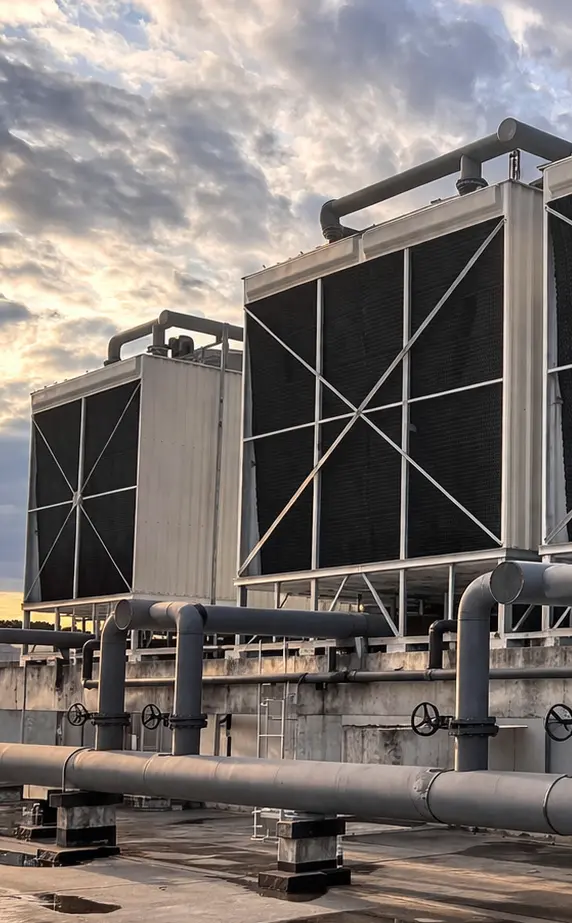
We provide chiller and cooling tower services for office buildings and corporate campuses with central chilled water plants, hospitals and healthcare facilities with continuous-operation cooling requirements, hotels and resort properties, government and tribal buildings, university and school district facilities, data centers and technology operations, manufacturing facilities with process cooling requirements, and large commercial buildings throughout Thurston, Pierce, Lewis, Cowlitz, Mason, and Grays Harbor Counties where central plant cooling is the primary means of building climate control.
Central plant expertise. Both loops. Water treatment. BAS integration. AIM Act current.
The most common chiller plant service failure in the South Sound's institutional building market isn't equipment breakdown — it's operating inefficiency that nobody has measured. A 500-ton water-cooled chiller running at 0.85 kW/ton instead of its rated 0.60 kW/ton is paying 42% more in electricity than it should for the same ton of cooling produced. That gap comes from condenser tube fouling that reduces heat transfer, a cooling tower operating below design airflow because of fan drive wear, condenser water that's been allowed to scale because the water treatment program lapsed, or a chiller that hasn't had an approach temperature analysis performed since its last overhaul. None of these conditions trigger an alarm. The chiller keeps running, keeps cooling the building, and keeps consuming 42% more electricity than the nameplate says it should — until someone measures it.
Chiller efficiency is measurable. A kW/ton measurement against design specification tells you precisely how much the system is costing per ton of cooling compared to what it should cost. Elite measures it. Most contractors don't.
Elite's EPA Section 608 certification covers all chiller refrigerant work — recovery, charging, leak testing, and documentation — for both legacy refrigerants (R-134a, R-410A) and the current generation of low-GWP alternatives (R-513A, R-1234ze(E), R-1233zd(E), R-32) that AIM Act-compliant chiller equipment uses. Our GC License ELITEMS796R2 and Electrical License ELITEMS787CH cover the full mechanical and controls scope. Our Tridium Niagara, JCI Facility Explorer, and ABB Cylon BACnet BAS credentials allow us to verify and optimize chiller plant controls — outdoor air economizer sequences, chiller staging and sequencing, condenser water reset, and chilled water reset — from within the building automation system rather than relying on local chiller controls in isolation from the building's overall mechanical strategy.
Chiller plant service contracts for publicly operated facilities — state agency buildings, tribal enterprise operations, school district central cooling plants, and publicly funded healthcare facilities — frequently carry supplier diversity requirements that score or mandate certified minority and disadvantaged business contractors for mechanical service agreements. Elite's MWBE (Cert #M1F0027854), DBE (Cert #D1F0027854), and PWSBE (Cert #P000027854) certifications qualify Elite for those procurement frameworks. For tribal enterprise operations with water-cooled chiller plants serving gaming and hospitality facilities — a market Elite specifically targets in Western Washington — our Indigenous-owned status under the Cowlitz Tribe creates additional alignment with tribal enterprise procurement preferences.
Chiller and Cooling Tower Within Your Complete Mechanical Program
A chiller plant doesn’t operate in isolation from the rest of a building’s mechanical infrastructure. The chilled water system distributes cooling to air handlers that are part of the HVAC system. The cooling tower’s water chemistry and blowdown management connect to the building’s plumbing infrastructure and water quality obligations. The chiller controls connect to the building automation system that also manages boilers, ventilation, and lighting. When the contractor managing the chiller plant is the same contractor who understands the BAS, the plumbing, and the HVAC systems it serves, optimization decisions — chilled water reset based on outdoor conditions, economizer mode coordination with the cooling tower, chiller staging relative to building load — can be made with full visibility into how each system affects the others. Elite’s multi-license, multi-credential scope makes that level of integration possible across a single service relationship.
Chiller Systems, Cooling Towers, and the Regulatory Context
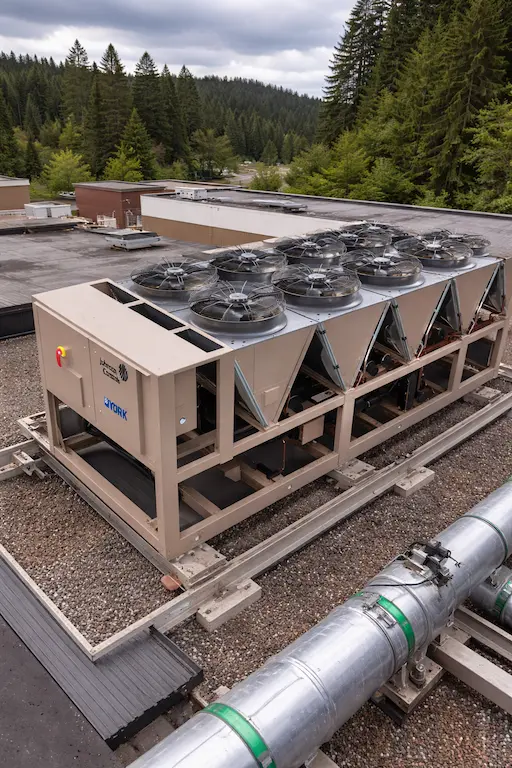
A water-cooled chiller and cooling tower operate as a two-loop system. The chilled water loop circulates cooled water from the chiller’s evaporator through the building’s air handlers and fan coil units, where the water absorbs heat from the building spaces before returning to the chiller to be re-cooled. The condenser water loop carries heat from the chiller’s condenser to the cooling tower, where evaporation rejects that heat to the atmosphere — and then returns the cooled condenser water to the chiller to start the cycle again. The chiller, condenser water pumps, chilled water pumps, cooling tower, and associated controls all operate as an integrated central plant. Air-cooled chillers — which use fans rather than a cooling tower to reject condenser heat — do not require a condenser water loop or cooling tower, but they are generally less efficient at high ambient temperatures and are typically used for smaller buildings or applications where a rooftop condenser is preferable to a mechanical room and roof-mounted tower.
The AIM Act’s 700 GWP limit for new comfort cooling equipment including chillers took effect January 1, 2025. Centrifugal and screw chillers traditionally used R-134a (GWP 1,430) — now replaced in new equipment with R-513A (GWP 573), R-515B (GWP 293), R-1234ze(E) (GWP less than 1), or R-1233zd(E) (GWP less than 1) depending on the manufacturer and compressor type. Scroll chillers traditionally used R-410A (GWP 2,088) — now replaced with R-32 (GWP 675) or R-454B (GWP 467). Existing chillers running legacy refrigerants are not required to retrofit — they can continue to be serviced with the original refrigerant charge. The practical implication for R-134a chiller operators is refrigerant cost and availability: as R-134a production decreases under the AIM Act phase-down, pricing and lead times for the refrigerant have been increasing. For facilities with aging R-134a chillers approaching the end of their service life, replacement planning that specifies AIM Act-compliant equipment from the outset avoids the alternative of an emergency replacement under refrigerant scarcity conditions.
Cooling tower water management is a regulatory obligation, not just a maintenance practice. Cooling towers are open-circuit evaporative systems — water cycles continuously through the tower basin, and dissolved minerals concentrate as water evaporates. Without controlled blowdown (the intentional discharge of concentrated system water) and makeup water addition, dissolved solids concentrate to levels that cause scale formation on condenser tubes and tower fill, and biological fouling including Legionella growth in the warm, aerated water environment. Cooling tower blowdown — the water discharged from the system to control dissolved solids concentration — is subject to Washington State water quality requirements under the Department of Ecology’s NPDES permit program when it discharges to surface water, groundwater, or a public sewer system with specific discharge limitations. Washington Ecology’s water quality permit requirements and guidance for commercial and industrial water discharges are available at ecology.wa.gov.
Your facility needs commercial chiller and cooling tower service attention if any of the following apply: your chiller’s kW/ton efficiency has not been measured against design specification in the past two years; your condenser tubes have not been mechanically cleaned and inspected within the past year; your cooling tower basin has not been drained, cleaned, and inspected within the past year; your cooling tower water treatment program has not been reviewed by a qualified water treatment professional in the past 12 months; or your facility has a cooling tower without a documented water management plan addressing Legionella risk under ASHRAE Standard 188. Healthcare facilities that receive Medicare or Medicaid reimbursements are specifically required by CMS to maintain water management programs — including cooling towers — per ASHRAE 188 guidance. For any facility with an open-circuit cooling tower, Legionella risk management is not optional maintenance — it is a building owner liability.

Our Chiller and Cooling Tower Service Process
Chiller and cooling tower service requires a systematic approach to both the mechanical equipment and the water chemistry — because a perfectly tuned chiller connected to a poorly managed cooling tower won’t perform to spec, and the reverse is equally true. Here’s how Elite approaches a chiller plant service engagement:

System documentation and baseline performance assessment
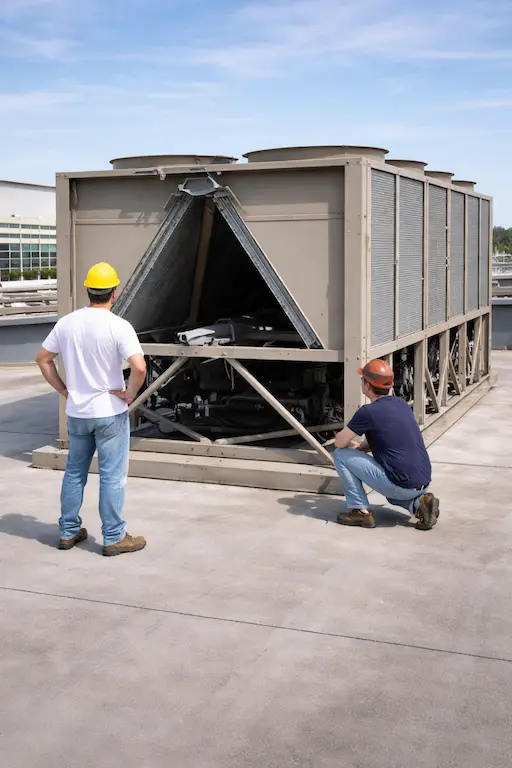
We begin by documenting the chiller plant — chiller model, vintage, refrigerant type, rated capacity, design COP, condenser and evaporator tube configuration, cooling tower model and design approach temperature, and condenser water pump configuration. We then measure actual operating conditions: chiller supply and return chilled water temperatures, condenser water supply and return temperatures, refrigerant suction and discharge pressures, compressor amp draw, and current kW/ton efficiency. Comparing measured kW/ton against the manufacturer's rated kW/ton under the same operating conditions tells us precisely how far the system has drifted from design performance — and provides the baseline for measuring improvement after service.

Condenser tube inspection and cleaning
Condenser tube fouling — scale and biological deposits on the inside of the chiller's condenser tubes — is the primary driver of chiller efficiency degradation in water-cooled systems. We inspect condenser tubes for scale, corrosion, and microbiological deposits, and perform mechanical tube cleaning using brushes or pneumatic cleaners sized for the tube diameter. For tubes showing signs of pitting corrosion, stress cracking, or wall thinning, we recommend eddy current testing by a qualified tube inspection service to assess tube integrity before the system is returned to service. A single failed condenser tube can contaminate the refrigerant circuit with condenser water — a catastrophic outcome that tube inspection and proactive replacement prevents.

Cooling tower inspection and cleaning
We drain the cooling tower basin, remove and inspect the fill media for scale accumulation and biological fouling, clean the basin and basin strainers, inspect the distribution system nozzles for blockage, inspect fan blades, bearings, and drive components, and verify that drift eliminators are installed and properly sealed. The tower is disinfected before return to service using a biocide treatment protocol that meets ASHRAE Guideline 12 recommendations for cooling tower restart after cleaning. We document the tower's physical condition and note any fill media degradation or structural concerns that affect its thermal performance.

Water treatment program review and adjustment
We review the cooling tower's current water treatment program — the biocide, scale inhibitor, and corrosion inhibitor dosing program — and test the condenser water for conductivity, pH, cycles of concentration, biocide residual, and inhibitor levels. If the program is not maintaining the condenser water within the target chemistry range for the system's metallurgy and operating conditions, we adjust dosing or recommend a program change. For facilities without a water treatment program in place, we identify this as a primary finding — an unmanaged cooling tower is a Legionella risk and a mechanical reliability risk regardless of how well the chiller itself is maintained.

Controls calibration and BAS integration verification
We verify that the chiller plant controls are operating as designed: chiller staging sequences for multi-chiller plants, condenser water reset (lowering condenser water temperature setpoint during mild weather to improve chiller efficiency), chilled water reset (raising chilled water supply temperature during reduced-load conditions), and economizer lockout sequences. For chiller plants connected to a Tridium Niagara, JCI Facility Explorer, or ABB Cylon BACnet BAS, we verify that BAS setpoint commands are reaching the chiller controls correctly, that alarm routing is active, and that efficiency trending data is being logged for ongoing performance monitoring.

Post-service performance measurement and documentation
After service is complete, we measure the system under load and document the post-service kW/ton efficiency against the pre-service baseline and the manufacturer's design specification. The improvement in efficiency is the quantifiable return on the service investment — expressed in kW/ton and translatable to annual energy cost savings based on the facility's operating hours and electricity rate. We provide a written service report documenting all pre- and post-service measurements, tube condition findings, water chemistry test results, controls verification results, and any recommendations for capital repair or replacement of components approaching the end of their service life.
Commercial Mechanical Contractor | Lacey, WA | Founded 2021
Chiller and Cooling Tower Services We Provide
Elite’s chiller and cooling tower scope spans the full range of central plant cooling work found in Western Washington’s commercial and institutional building market:
Chiller Maintenance and Efficiency Optimization
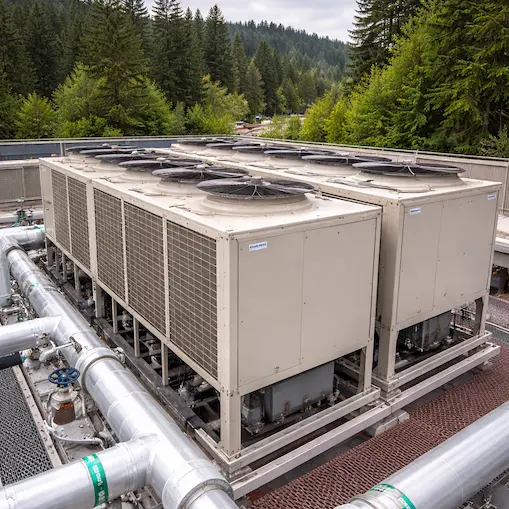
Annual chiller maintenance covers refrigerant leak testing and charge verification, condenser and evaporator tube inspection, condenser tube mechanical cleaning, compressor oil sampling and analysis, bearing condition assessment, controls calibration and setpoint verification, approach temperature measurement, and full operating log documentation. For facilities operating multiple chillers in a central plant, we extend this scope to assess each chiller individually and to evaluate the staging strategy — confirming that the lead-lag sequence and load distribution between chillers is optimized for the building's actual load profile rather than defaulting to equal runtime regardless of efficiency differences between units. Chiller efficiency optimization is distinct from annual maintenance — it is an analytical exercise that identifies whether the system is achieving its rated kW/ton under current operating conditions, diagnoses the gap if it isn't, and quantifies the energy cost of that gap in dollars per year. For large chiller plants in government buildings, healthcare facilities, and corporate campuses where chiller electricity consumption is a significant line item, efficiency optimization is one of the highest-return mechanical services available — frequently identifying energy cost savings that exceed the annual maintenance contract value.
Cooling Tower Maintenance and Water Treatment
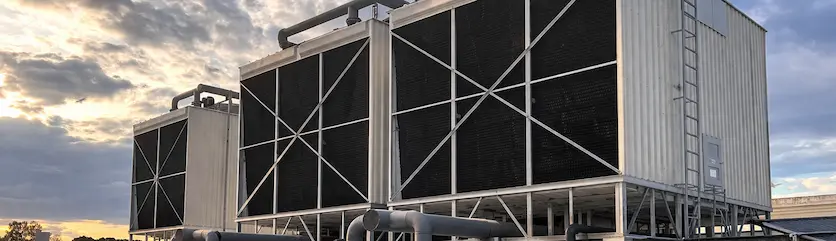
Annual cooling tower maintenance covers basin cleaning, fill media inspection and replacement where necessary, fan and drive inspection, distribution nozzle cleaning, drift eliminator inspection, structural inspection of the tower casing and support structure, and a comprehensive startup disinfection before the cooling season begins. Cooling tower startup disinfection is particularly important for systems that sit idle during winter months — dormant towers accumulate sediment and allow Legionella and other biofilm-forming organisms to establish in the basin and fill before the system is restarted. ASHRAE Guideline 12 describes the recommended startup protocol for cooling towers returning to service after a seasonal shutdown. Water treatment program management covers quarterly condenser water testing, biocide dosing adjustment, scale and corrosion inhibitor maintenance, and blowdown control to maintain cycles of concentration within the target range for the system's makeup water quality and metallurgy. For facilities where the cooling tower blowdown discharges to a surface water body or public sewer with specific discharge limitations, we coordinate the water treatment program to ensure blowdown chemistry meets the applicable discharge requirements under Washington Ecology's water quality permit framework.
Chiller Plant Installation and Replacement
Commercial chiller installation requires mechanical permit from the local AHJ, refrigerant handling under EPA Section 608, coordination with the building's electrical service for compressor power, and connection to the existing chilled water and condenser water distribution infrastructure. For chiller replacements on AIM Act-compliant refrigerants, we specify equipment using the current generation of low-GWP refrigerants — R-513A or R-1234ze(E) for centrifugal and screw chillers replacing R-134a equipment, R-32 or R-454B for scroll chillers replacing R-410A equipment — and verify that the existing piping, controls, and water chemistry program are compatible with the new refrigerant and equipment design. For facilities replacing aging chiller plants, the replacement decision involves more than equipment selection. The distribution system — piping, pumps, valves, and air handlers — must be evaluated for compatibility with the new chiller's supply water temperature and flow rate. A chiller that was designed around a 44°F chilled water supply temperature may require distribution system modifications if the replacement unit operates most efficiently at a different temperature or flow rate. Elite evaluates the complete central plant system before specifying replacement equipment, so the new chiller is matched to the building's actual distribution infrastructure rather than specified in isolation.
Cooling Tower Installation and Replacement
Cooling tower installation and replacement involves structural assessment of the roof or ground support structure, connection to the condenser water distribution piping, fan and drive installation, makeup water connection with a code-required reduced pressure backflow preventer assembly under WAC 246-290-490 (cooling towers are high-hazard cross-connection points), and startup commissioning including initial water chemistry establishment and disinfection. Tower sizing must match the chiller's condenser heat rejection rate at design conditions — an undersized tower that can't maintain the required leaving water temperature forces the chiller into high condenser water temperature operation, reducing efficiency and in extreme cases triggering high-pressure lockouts.
Legionella Risk Management and ASHRAE 188 Compliance
ASHRAE Standard 188 — Legionellosis: Risk Management for Building Water Systems — requires building operators to develop and implement a water management program for cooling towers and other water systems that can amplify and aerosolize Legionella. The standard is referenced by the Centers for Medicare and Medicaid Services (CMS) as the basis for water management program requirements at Medicare-certified healthcare facilities. For any facility with a cooling tower — particularly hospitals, long-term care facilities, hotels, and large office buildings — a documented water management plan that addresses the tower's Legionella risk is an ownership liability issue that ASHRAE 188 provides the framework to address. Elite helps facilities develop and implement ASHRAE 188-aligned water management programs for their cooling tower systems — documenting the system, identifying Legionella hazard points, establishing control measures including water temperature management, biocide dosing, and periodic testing, and maintaining the records that demonstrate the program is being followed. For healthcare facilities subject to CMS requirements and Joint Commission accreditation standards, this documentation is a direct accreditation requirement, not an optional best practice.
One Contractor. Every System. The Whole Region.
If you don’t know your chiller’s current kW/ton efficiency or when your cooling tower basin was last cleaned, those are the two numbers worth finding out. Contact Elite Mechanical Services at (360) 489-0717 to schedule a chiller plant assessment. We serve commercial and institutional facilities across Lacey, Olympia, Tumwater, Tacoma, and Western Washington.
Chiller and Cooling Tower Services Across Western Washington
Government and Institutional Buildings — Aging Chiller Plant Infrastructure
Thurston County’s concentration of state agency buildings, county facilities, and government offices represents one of the largest inventories of aging water-cooled chiller plant infrastructure in Western Washington. Many of these buildings operate chiller systems installed in the 1990s and early 2000s — equipment that has reached or exceeded its 25–30 year design life, running on legacy refrigerants that are increasingly expensive and difficult to source, and operating at efficiency levels that bear no resemblance to the nameplate specification because of years of deferred maintenance on condenser tubes, cooling towers, and controls. Elite’s MWBE, DBE, and PWSBE certifications qualify us for the state and county procurement frameworks that govern mechanical service contracts for these facilities — and our BAS credentials allow us to integrate chiller plant performance monitoring directly into the building automation systems that many of these buildings have upgraded to in recent years.
Healthcare Facilities — Continuous Operation and ASHRAE 188
Hospitals and healthcare facilities in the Pierce County healthcare corridor — Tacoma, Lakewood, and the outpatient clinic concentration in Puyallup and University Place — operate chiller plants under conditions that combine high cooling loads, continuous operation requirements, and the additional regulatory dimension of ASHRAE 188 water management program compliance. A healthcare facility cooling tower without a documented, implemented water management plan is a CMS compliance exposure and a Joint Commission accreditation risk. Elite provides both the mechanical chiller and cooling tower service and the ASHRAE 188-aligned water management program documentation that healthcare facility accreditation requires. For facilities in Thurston County’s Capital Medical Center area and the Olympia healthcare corridor, the same combination of mechanical service and compliance documentation applies.
Hotels, Hospitality, and Large Commercial Buildings
Hotels, resort properties, and large mixed-use commercial buildings with central chilled water plants represent the highest-intensity chiller service market in Western Washington — continuous operation during peak occupancy seasons, high condenser loads from kitchen and laundry heat generation, and guest comfort standards that make chiller plant reliability a revenue-affecting operational issue, not just a maintenance line item. A hotel chiller failure during a summer weekend in Tacoma or a conference booking at an Olympia hotel involves guest experience and revenue consequences beyond the repair cost. Elite structures annual service agreements for hospitality properties that keep chiller and cooling tower equipment in documented, verified condition year-round — not just in response to a failure.
- Government buildings and state agency facilities with aging water-cooled chiller plant infrastructure
- Hospitals and healthcare facilities requiring ASHRAE 188 water management plan compliance
- Hotels and hospitality properties with continuous-operation central chilled water plants
- Corporate campuses and office buildings with multi-chiller central plant systems
- Tribal enterprise operations with large-capacity cooling requirements
- School districts and universities with central chilled water cooling systems
- Data centers and technology operations with precision cooling requirements
- Manufacturing and industrial facilities with process cooling chiller systems
- Facilities with air-cooled chillers requiring AIM Act-compliant refrigerant planning
- Any building where the chiller's kW/ton efficiency has never been measured against design specification
Facilities We Serve for Chiller and Cooling Tower Services
The common denominator across Elite’s chiller plant clients is scale — these are facilities large enough that the chiller is a significant energy consumer and a critical operational dependency. A chiller failure in a data center, a hospital, or a hotel isn’t a comfort issue — it’s a business continuity event. The service program that prevents that event is worth significantly more than its annual cost.
All chiller and cooling tower work is commercial and institutional only — not portable chillers, not residential geothermal systems, not small-building package units. Central plant chiller service operates under a different technical, refrigerant, and water treatment standard than residential or light commercial HVAC, and our team is calibrated to that standard exclusively.
Chiller and Cooling Tower Service Area — Western Washington
Elite Mechanical Services provides chiller and cooling tower services across all six counties in our Western Washington service area — Thurston, Pierce, Lewis, Cowlitz, Mason, and Grays Harbor. In Thurston County, the state government building campus in Olympia represents the largest single concentration of water-cooled chiller plant equipment in the region — aging systems in capitol complex buildings and state agency offices that require both ongoing maintenance and capital replacement planning as equipment reaches end of life. The commercial office market in Lacey’s Hawks Prairie area and the Tumwater commercial corridor also includes buildings with central chilled water plants that have been operating for 15–25 years without comprehensive efficiency assessments. These are facilities where a kW/ton measurement and condenser tube inspection often reveal improvement opportunities that more than justify the cost of the assessment.
Pierce County’s chiller service market is anchored by the Tacoma healthcare campus — MultiCare, CHI Franciscan, and the outpatient clinic concentration in the surrounding corridors — along with the corporate campus market in DuPont and Lakewood and the hospitality and hotel concentration in downtown Tacoma and the Puyallup/Federal Way corridor. For commercial property managers in Pierce County overseeing multiple buildings with central cooling plants, Elite structures multi-site chiller service agreements that provide a single maintenance schedule, consistent documentation, and one service relationship for all chiller plant equipment across the portfolio.
Lewis County’s Centralia-Chehalis industrial corridor and Cowlitz County’s Longview and Kelso market add process cooling chiller applications to the commercial building cooling demand. Industrial facilities with process cooling requirements — food processing, pharmaceutical manufacturing, and precision manufacturing operations — often run chiller systems outside of standard comfort cooling operating parameters, with lower chilled water supply temperatures and higher continuous duty cycles than typical building HVAC chillers. Elite’s chiller service capability extends to these applications as part of our standard Western Washington service footprint. Mason and Grays Harbor Counties add tribal facility and coastal commercial chiller work to our coverage area.
Check out our full service area across Western Washington, or call (360) 489-0717 to discuss your facility’s chiller plant service or assessment needs.
Why Choose Elite for Chiller and Cooling Tower Services
Commercial chiller service done correctly requires competency in three domains simultaneously: the refrigerant side of the chiller (EPA Section 608 compliance, refrigerant identification, charge verification, leak testing), the water side of the system (condenser tube inspection and cleaning, cooling tower maintenance, water treatment program management, blowdown chemistry), and the controls side (BAS integration, chiller staging optimization, condenser water and chilled water reset sequences). Most contractors are strong in one of these domains. The ones who are weak in the water side — who service the refrigerant circuit correctly but haven’t addressed the condenser tubes or the cooling tower water treatment in years — are the reason chiller plants operate at 40% above rated energy consumption and nobody knows why. Elite brings all three domains to every chiller plant engagement, and measures the result with a kW/ton efficiency assessment before and after every service visit.
- EPA Section 608 certified — all chiller refrigerant recovery, charging, leak testing, and documentation compliant for both legacy and AIM Act refrigerants
- AIM Act current — informed on chiller refrigerant transition timeline; R-513A, R-1234ze, R-1233zd, R-32 all within our service capability
- GC License: ELITEMS796R2 — full chiller plant installation and replacement scope
- Electrical License: ELITEMS787CH — chiller power connections, VFD installation, and controls wiring in-house
- Tridium Niagara | JCI Facility Explorer | ABB Cylon BACnet — chiller plant BAS integration, efficiency trending, and alarm routing
- Plumbing License: ELITEMS761BC — cooling tower makeup water connections, backflow prevention, and blowdown piping
- Union contractor — union-trained technicians on every commercial chiller plant service engagement
- MWBE Cert #M1F0027854 | DBE Cert #D1F0027854 | PWSBE Cert #P000027854 — qualified for public and tribal facility service contracts
- Bond capacity: $750,000 single project | $1.2 million aggregate
- Founded 2021 | Minority-owned, woman-owned, Indigenous-owned (Cowlitz Tribe), Latino-owned
A chiller plant that’s never been measured isn’t being managed — it’s being operated. The difference between the two shows up in the electricity bill, in the lifespan of the compressor running harder than it should, in the condenser tubes corroding because the water chemistry wasn’t right, and eventually in a replacement that happens earlier than it needed to. Elite brings the measurement capability, the water treatment knowledge, the refrigerant expertise, and the BAS integration to manage a chiller plant rather than just operate it.
What is the difference between an air-cooled and a water-cooled chiller?
An air-cooled chiller uses fans to blow ambient air across the condenser to reject heat from the refrigerant circuit. No cooling tower is required — the condenser is typically located on the roof or building exterior, and heat is rejected directly to the surrounding air. Air-cooled chillers are simpler to maintain (no condenser water loop, no cooling tower, no water treatment program), but they are generally less efficient at high ambient temperatures and are limited in practical capacity to roughly 500 tons in most commercial configurations. A water-cooled chiller rejects condenser heat to a separate condenser water loop that circulates between the chiller's condenser and a cooling tower, where heat is rejected through evaporation. Water-cooled chillers are more efficient because evaporative cooling allows condenser water temperatures significantly below ambient air temperature — and lower condenser water temperature means better chiller efficiency. The tradeoff is the additional infrastructure of the cooling tower, condenser water pumps, and water treatment program. Most large commercial and institutional buildings with central chilled water plants use water-cooled chillers.
What is ASHRAE 188 and does my facility need a water management plan?
ASHRAE Standard 188 — Legionellosis: Risk Management for Building Water Systems — requires building operators to develop and implement a water management program for cooling towers, domestic hot water systems, and other building water systems that can amplify and transmit Legionella bacteria. The standard is voluntary at the federal level, but the Centers for Medicare and Medicaid Services (CMS) issued a 2017 directive requiring Medicare-certified healthcare facilities — hospitals, long-term care facilities, critical access hospitals — to maintain water management programs consistent with ASHRAE 188. Any facility with a cooling tower — particularly healthcare facilities, hotels, and large office buildings with vulnerable occupant populations — should have a documented water management plan. Washington state does not currently have mandatory cooling tower registration or Legionella testing requirements comparable to New York's regulations, but the ASHRAE 188 framework is the industry standard for demonstrating that a facility is managing its cooling tower Legionella risk responsibly. The liability exposure from a Legionnaires' disease case linked to a poorly maintained cooling tower far exceeds the cost of implementing a water management program.
Can Elite integrate chiller plant performance monitoring with our existing building automation system?
Yes. For chiller plants connected to a Tridium Niagara, JCI Facility Explorer, or ABB Cylon BACnet building automation system, Elite can integrate chiller operating data — supply and return water temperatures, condenser water temperatures, compressor amp draw, kW/ton efficiency — into the BAS trending and alarm management system. This enables continuous performance monitoring: the BAS logs the chiller’s efficiency trend over time, flags deviation from baseline performance, and routes alarms to the appropriate notification destination when efficiency degrades beyond a set threshold. It also enables optimization sequences — condenser water temperature reset based on outdoor wet-bulb conditions, chilled water supply temperature reset based on building load, and chiller staging logic that sequences multiple chillers based on efficiency rather than just runtime hours. For facilities making the case for chiller replacement or capital upgrade, the BAS efficiency trend data provides the documented evidence of efficiency degradation that justifies the capital investment.
What refrigerants does Elite service in commercial chillers?
Elite services commercial chillers using both legacy refrigerants and the current generation of AIM Act-compliant low-GWP alternatives. Legacy refrigerants in existing chiller equipment include R-134a (used in centrifugal and screw chillers) and R-410A (used in some scroll chillers). These refrigerants can continue to be used to service existing equipment — the AIM Act's 700 GWP limit applies to new equipment, not operating systems. Current-generation chiller refrigerants include R-513A and R-1234ze(E) for centrifugal and screw chillers replacing R-134a equipment; R-1233zd(E) for low-pressure centrifugal applications; and R-32 and R-454B for scroll chillers replacing R-410A equipment. Our EPA Section 608 certified technicians handle recovery, charging, and leak testing for all of these refrigerant types, and we can advise on the refrigerant cost and availability trajectory for any legacy refrigerant in your existing equipment to inform replacement planning decisions.
How often should commercial chillers and cooling towers be serviced?
Commercial chillers should receive comprehensive annual maintenance covering refrigerant leak testing, condenser tube cleaning, oil analysis, bearing inspection, and controls calibration — plus an efficiency measurement (kW/ton against design specification) at each visit. For chillers in continuous operation (data centers, hospitals), semi-annual tube inspection is appropriate. Cooling towers should receive seasonal startup service each spring before the cooling season begins, covering basin cleaning, disinfection, fan drive inspection, and water chemistry establishment. Quarterly water treatment testing and adjustment keeps condenser water chemistry within target parameters throughout the season. Annual tower inspection in the fall, before winter shutdown, assesses fill media condition and structural integrity. For healthcare facilities with ASHRAE 188 water management program requirements, cooling tower Legionella testing should follow the frequency specified in the facility's water management plan — typically quarterly at minimum.
Commercial Mechanical Contractor | Lacey, WA | Founded 2021
Frequently Asked Questions
Your Chiller's Efficiency Is Measurable. Your Cooling Tower's Water Isn't Optional.
Elite Mechanical Services provides commercial chiller and cooling tower installation, maintenance, efficiency optimization, water treatment, and ASHRAE 188 water management program support for facilities across Lacey, Olympia, Tumwater, Tacoma, and Western Washington. EPA Section 608 certified. AIM Act current. BAS integration capable. Plumbing-licensed for makeup water and backflow prevention. Call (360) 489-0717, email admin@elitemechsvcs.com, or fill out our online quote request form.