
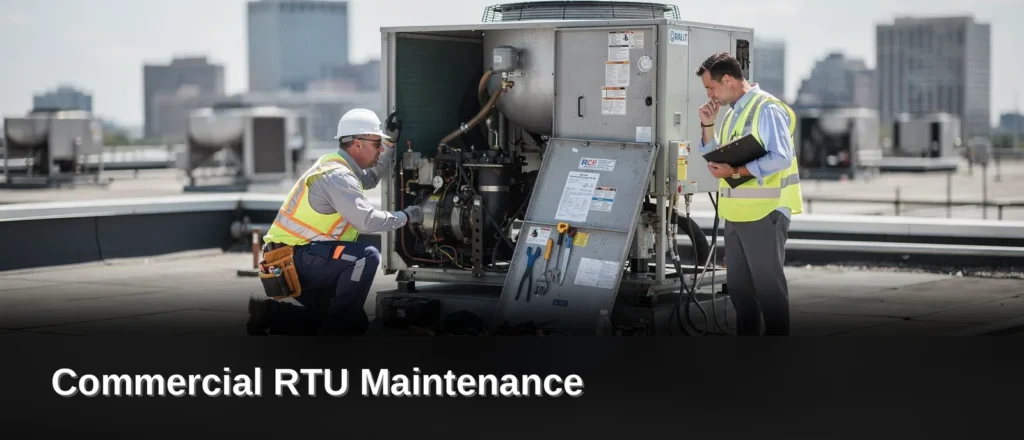
Preventative maintenance separates facilities managers who avoid five-figure emergency repairs from those who don’t: catching worn belts, dirty coils, and loose wiring early extends rooftop unit lifespan by five to ten years. Elite Mechanical Services, LLC helps Lacey, WA property managers build maintenance schedules that stop small issues before they become costly shutdowns.
Facilities managers prevent costly RTU failures through scheduled preventive maintenance that catches worn belts, dirty coils, and loose wiring before they escalate into emergency breakdowns. Routine inspections extend rooftop unit lifespan by five to ten years, reduce energy costs, and maintain code compliance. Elite Mechanical Services performs commercial RTU maintenance and troubleshooting across the South Sound region, backed by EPA-certified, union-trained technicians.
Key Takeaways
- Preventative maintenance extends commercial RTU lifespan by five to ten years and controls operating costs.
- Small issues like worn belts and dirty coils grow into major failures when left unchecked.
- Early detection through routine maintenance prevents emergency repair bills and operational disruptions.
- Elite Mechanical Services helps facilities managers catch RTU problems before they affect comfort and energy use.
Why Do RTU Failures Cost So Much?
Rooftop unit failures cost commercial property managers far more than a repair invoice. Commercial RTU maintenance stands as the single highest-leverage investment a facilities team can make to control HVAC operating costs, sidestep emergency repair bills, and extend equipment life by five to ten years. Skip it, and the savings never materialize — they just show up later as replacement costs.
The scale of exposure is what makes rooftop equipment different from other building systems. Rooftop units handle heating, cooling, and ventilation across millions of square feet of commercial space nationwide. When one fails, the damage rarely stays contained to a single mechanical room.
What happens when an RTU goes down unexpectedly?
A single failure ripples outward fast. Tenants lose comfort and productivity, occupancy rates take a hit, and operating budgets absorb the shock all at once — not sequentially, but simultaneously. For a multi-tenant office building or institutional facility, that combination turns a mechanical problem into a business problem within hours.
Consider what’s riding on a properly maintained rooftop system:
- Tenant comfort and lease retention
- Occupancy commitments tied to functioning HVAC
- Emergency service premiums versus scheduled maintenance rates
- Equipment replacement costs pulled years earlier than necessary
Who should manage ongoing RTU maintenance programs?
Facility managers, building owners, and institutional decision-makers need a commercial mechanical contractor with the licensing and local presence to respond before small issues become failures. Elite Mechanical Services is a licensed, union commercial mechanical contractor based in Lacey, WA, serving facility managers, building owners, and property managers from Tacoma and Puyallup south through Olympia, Tumwater, and Lacey, continuing along the I-5 corridor. That regional footprint matters when a rooftop unit fails at 6 a.m. on a Monday and tenants expect answers by 8.
What Causes Most Rooftop Unit Breakdowns?
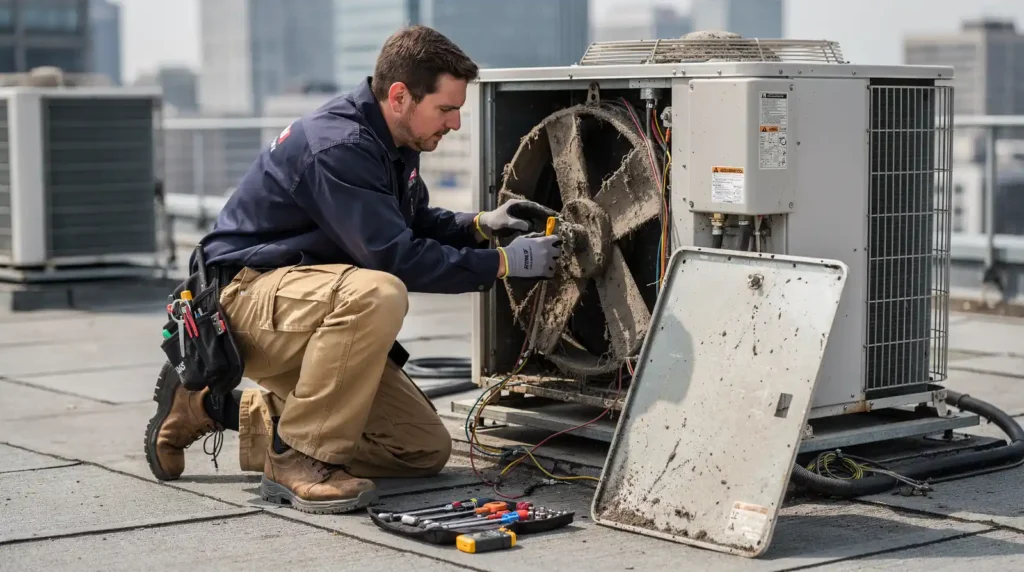
Sudden rooftop unit failures almost never happen without warning. Breakdowns build gradually, starting as minor mechanical faults that operations directors and building engineers can catch long before a unit goes down mid-shift.
A worn belt does not become a compressor failure overnight. Small issues compound quietly:
- Worn or slipping belts that reduce airflow and strain the motor
- Dirty coils that force the system to work harder for the same output
- Loose electrical connections that create intermittent faults and safety risks
Left unaddressed, any one of these can escalate into a full unit failure, an event that disrupts tenant comfort and shuts down operations without notice.
Why does preventative maintenance matter so much for RTUs?
Preventative maintenance catches worn belts, fouled coils, and loose wiring while they’re still cheap fixes. Skipping inspection cycles lets these small faults compound into compressor damage, control failures, or complete system shutdown. The kind of failure that pulls facilities staff into emergency response instead of scheduled service.
Effective commercial hvac preventative maintenance requires technicians who understand more than the rooftop unit itself. Elite Mechanical Services’ scope covers commercial HVAC, boilers, building automation, plumbing, and refrigeration, giving technicians the range to diagnose control issues and mechanical faults that often sit upstream of an RTU complaint. A control fault flagged in the building automation system, for example, can be the actual root cause behind a rooftop unit that seems to be cycling incorrectly.
Do all commercial equipment failures carry the same urgency?
No. Equipment-specific risk profiles determine how fast a response needs to move. A refrigeration failure at a commercial kitchen, for instance, is treated as a different category of emergency than an HVAC breakdown, since spoiled inventory and health code exposure accumulate within hours. Rooftop units carry their own risk profile: comfort and code compliance rather than perishable loss, but the underlying lesson holds. Early diagnosis prevents costly emergencies across every mechanical system.
How Often Should Commercial RTUs Be Serviced?
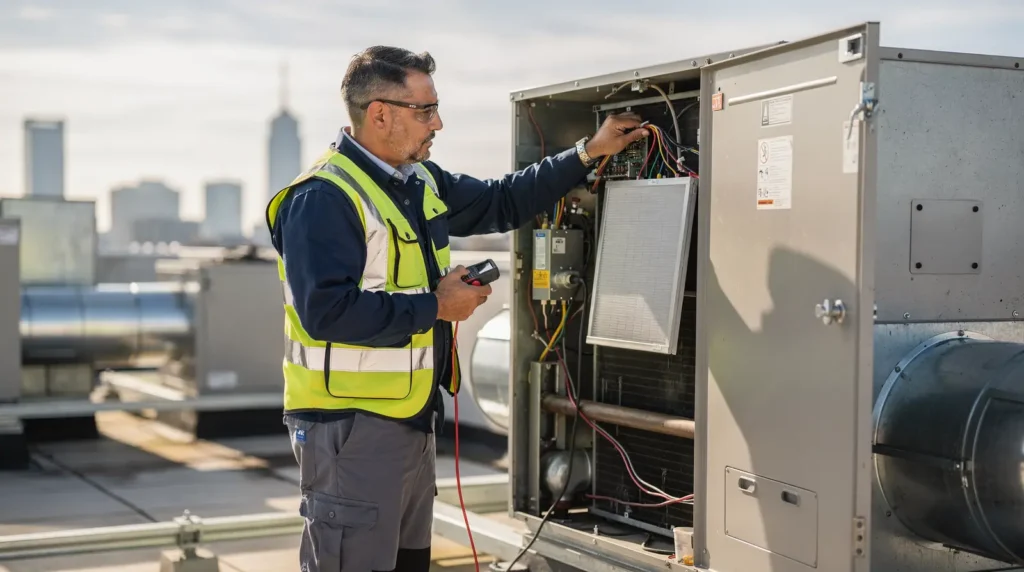
Most commercial rooftop units need professional service at least twice yearly, once before cooling season and once before heating season. Facility managers who wait for a breakdown to call for service pay more in emergency repair costs. Lost tenant comfort than those who commit to commercial hvac preventative maintenance on a fixed schedule. Small mechanical problems rarely announce themselves loudly. A worn belt, a dirty coil, or a loosening electrical connection develops quietly for weeks before it forces a system offline.
Scheduled visits catch these developing issues before they affect occupant comfort, spike energy consumption, or interrupt daily operations. That early detection is the entire value proposition behind commercial rtu maintenance: it converts an unpredictable failure into a planned repair line item. Buildings that skip inspections trade a modest maintenance cost now for a far larger, unscheduled cost later.
Why does seasonal timing matter for RTU service?
Seasonal transitions mark the most critical windows for scheduling rooftop unit work. Units that idle through a mild season often carry hidden wear into the next extreme-temperature stretch, where the added strain exposes every weak component at once. Servicing ahead of both summer and winter peaks gives technicians a chance to correct problems before the equipment is asked to perform under maximum load.
What determines the right maintenance frequency for a specific building?
Occupancy patterns, building age, and unit run-hours all influence how often a facility needs service beyond the standard twice-yearly baseline. A property running units near-continuously may warrant more frequent checks than a seasonal-occupancy building.
Elite Mechanical Services, based in Lacey, WA, positions its technicians centrally across the South Sound for recurring visits without long response delays. As a commercial mechanical contractor, the firm holds that building systems needing attention deserve a provider with proper credentials and qualified staff on every call, a standard that protects commercial rooftop unit lifespan across the full service life of the equipment.
What Belongs on a Seasonal RTU Checklist?
A seasonal checklist covers mechanical components, electrical connections, refrigerant levels, and the gas or condensate lines feeding the unit. Rooftop equipment operates as the unsung hero of daily commercial operations, working behind the scenes to protect comfort, tenant satisfaction, and sensitive equipment inside the building. When facility teams skip a season, small wear items turn into failures that surface at the worst possible moment.
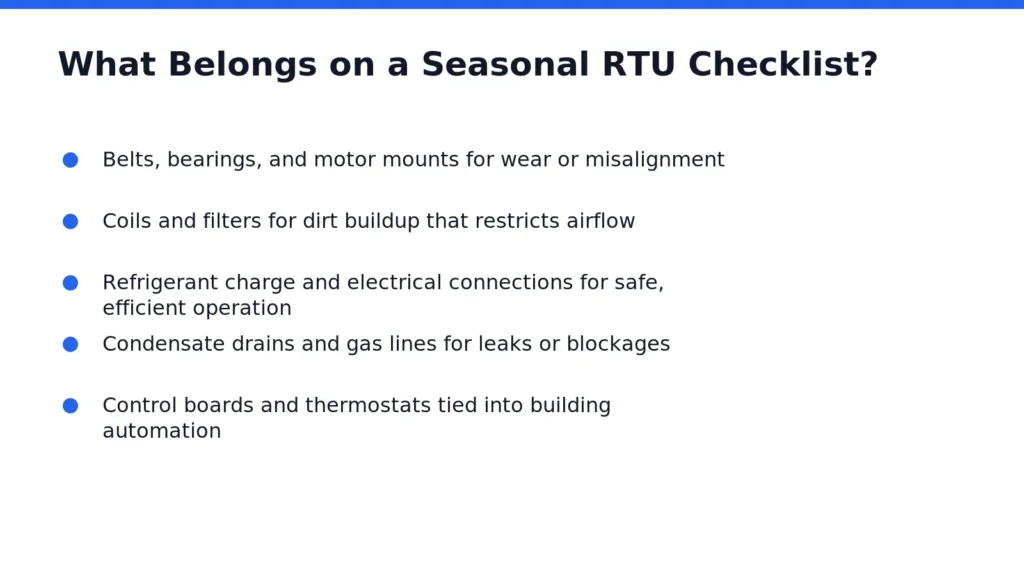
Commercial RTU maintenance programs typically inspect these areas each visit:
- Belts, bearings, and motor mounts for wear or misalignment
- Coils and filters for dirt buildup that restricts airflow
- Refrigerant charge and electrical connections for safe, efficient operation
- Condensate drains and gas lines for leaks or blockages
- Control boards and thermostats tied into building automation
Who Should Handle Gas and Condensate Line Work?
Licensed trades, not general maintenance staff, should handle gas and condensate connections. Washington restructured its plumbing contractor licensing in 2021, eliminating a shortcut that once let general contractors perform certain trade-connected work without a dedicated license. Since July 2021, a general contractor registration alone no longer authorizes that work in Washington. Facility managers scheduling seasonal inspections should confirm the contractor holds the correct trade licenses before line work begins.
Does One Contractor Cover the Whole System?
A single commercial mechanical contractor can typically handle the full scope a seasonal inspection touches. Coverage spanning commercial HVAC, boilers, building automation, and plumbing means one team can move from the rooftop unit to the connected gas line without a second vendor call. That consolidation matters most during preventative maintenance visits, when a technician finds an issue outside the original scope and needs licensed authority to address it on the spot rather than scheduling a return trip.
How Do You Troubleshoot RTU Problems Fast?
Fast rooftop unit troubleshooting starts with a structured diagnostic sequence, not guesswork. Commercial hvac troubleshooting moves fastest when technicians follow a defined order: verify power and controls, check airflow, inspect refrigerant charge, then test electrical components. Skipping steps costs time, and time is the one resource facility managers cannot recover during a breakdown.
Commercial HVAC failures rarely strike at a convenient hour. They tend to surface during peak occupied periods, when a building is full and disruption costs the most. A rooftop unit that stops working mid-shift creates an immediate chain reaction: uncomfortable employees, frustrated customers, and operational disruption that ripples through the workday.
What's the first step when an RTU stops working?
Confirm the thermostat call and verify power at the disconnect before assuming a major component failure. Many “no-cool” or “no-heat” calls trace back to a tripped breaker, a blown fuse, or a control signal that never reached the unit. Ruling out these simple causes first saves hours of unnecessary diagnostic work.
Why does fast troubleshooting matter for facility budgets?
Delayed diagnosis extends downtime, and extended downtime multiplies disruption costs across tenants and operations. Elite Mechanical Services treats every mechanical emergency with the same urgency applied to refrigeration failures. The service clock runs in hours, not days. That standard carries over directly to rooftop unit response.
A practical troubleshooting checklist includes:
- Verify thermostat calls and control voltage
- Inspect air filters and airflow restrictions
- Check refrigerant pressures against manufacturer specifications
- Test capacitors, contactors, and motor windings
- Confirm condensate drainage is clear
Refrigerant-related diagnostics require EPA Section 608 certification, the federal credential governing safe refrigerant handling. Elite Mechanical Services performs this refrigerant-related repair and maintenance work under that certification, ensuring diagnostics stay both fast and compliant.
What Extends Commercial Rooftop Unit Lifespan?
Consistent preventative maintenance drives rooftop equipment lifespan more than any other single factor. Neglected units typically fail five to ten years earlier than units on a structured maintenance schedule. That gap represents an early capital replacement decision most facilities directors would rather avoid.
Commercial rooftop unit lifespan depends on more than routine filter changes and coil cleaning. Gas lines, condensate drains, and other plumbing connections tie directly into rooftop equipment, and problems in those connections shorten equipment life just as fast as a neglected coil. Washington State tightened the rules around who can touch that connected work. Under Chapter 18.106 RCW, plumbing contract work now requires a licensed plumbing contractor with a journey-level or specialty plumber on staff — a general contractor registration alone no longer qualifies.
Does licensing actually affect how long a rooftop unit lasts?
Licensing determines who is legally authorized to perform the connected trade work that keeps a rooftop unit running safely. Condensate lines, gas connections, and other plumbing tie-ins that aren’t installed or serviced to code create failure points that shorten equipment life. Elite Mechanical Services holds Plumbing Contractor License ELITEMS761BC, the credential Washington state requires for this scope of work.
What role does the contractor relationship play in equipment longevity?
A facility that treats rooftop maintenance as a one-off repair call loses the continuity that protects equipment over time. Elite Mechanical Services operates as a licensed, union commercial mechanical contractor based in Lacey and serving the South Sound region, built around long-term equipment stewardship rather than reactive fixes.
Facilities directors evaluating commercial hvac preventative maintenance programs should look for:
- A single contractor covering both mechanical and plumbing scope
- Documented licensing for connected trade work
- A maintenance cadence, not just emergency dispatch
- Commercial hvac troubleshooting capability paired with code-compliant repair authority
That combination is what separates a unit that reaches its full service life from one replaced years ahead of schedule.
Who Should Perform RTU Maintenance and Repairs?
Trained technicians, not general handymen or in-house staff without HVAC credentials, should inspect and service rooftop units. Facilities managers need a commercial mechanical contractor who shows up with the right credentials and the right people. Not a contractor whose experience lies in a different trade entirely. Rooftop systems carry electrical, refrigerant, and combustion components that demand specific certification to handle safely.
The case for qualified technicians runs deeper than compliance paperwork. Many rooftop unit failures show detectable warning signs long before a complete breakdown occurs, but spotting those signs requires someone trained to recognize them. A worn belt, a failing capacitor, or a refrigerant leak rarely announces itself to an untrained eye. Only a technician who performs commercial HVAC troubleshooting routinely will catch these signals during a routine visit rather than during an emergency call.
Why does the stakes level matter for who gets hired?
Equipment failure in a commercial building doesn’t stay contained to one system. When a walk-in cooler loses temperature overnight, the consequences include lost inventory, a compliance notification requirement, and a business interruption that starts the moment staff discover the problem. RTU failures pose that same category of operational risk to occupied office space, retail floors, and patient care areas. That risk level is exactly why [commercial HVAC preventative maintenance](https://elitemechsvcs.com/services/commercial-hvac/) belongs with a licensed, credentialed contractor rather than a general repair service.
What should a facilities manager look for in a maintenance provider?
A qualified provider should demonstrate:
- Verifiable licensing for mechanical and, where applicable, electrical work
- Technicians trained specifically on rooftop and packaged commercial systems
- Local response capability within the service area
- A documented preventive maintenance process, not reactive repair only
Elite Mechanical Services, based in Lacey, WA, positions its credentialed technicians to respond across the South Sound region, supporting commercial rooftop unit lifespan goals through consistent, qualified service.
What Should Facilities Managers Do Next?
Building a maintenance schedule matters less than committing to one and sticking with it. Facilities managers who treat rooftop units as a line-item afterthought pay for that decision later, through premature compressor failure, spiking utility bills, or a mid-summer breakdown that empties a building. A structured maintenance plan represents a modest investment compared against the cost of lost productivity or an early system replacement triggered by years of neglect.
The next practical step is consolidation. Coordinating separate vendors for HVAC, controls, and plumbing creates gaps where problems slip through unnoticed. Elite Mechanical Services’ scope covers commercial HVAC, boilers, building automation, plumbing, and preventative maintenance, allowing one contractor to manage an entire rooftop unit program from a single point of accountability.
Who Handles RTU Maintenance for Facilities Across the South Sound?
Facility managers, property managers, and institutional decision-makers throughout Tacoma, Puyallup, Olympia, Tumwater, and Lacey rely on Elite Mechanical Services for ongoing RTU support. Coverage extends further down the I-5 corridor, giving multi-site operators a consistent contractor across several service areas rather than a patchwork of regional vendors.
How Should a Facilities Team Choose a Maintenance Partner?
Credentials matter more than a low bid. A commercial mechanical contractor with the right licensing and trained staff prevents the compliance headaches. Callback cycles that come from underqualified crews. Facilities teams should prioritize:
- Verified licensing and technician credentials
- Documented preventive maintenance history
- Single-vendor capability across HVAC, controls, and plumbing
- Responsiveness for emergency repair calls
Building systems needing attention deserve a partner that shows up prepared, not one learning on the job. That readiness is the difference between a minor repair and a full system replacement.
FAQ
How much does preventive RTU maintenance extend equipment life?
Scheduled maintenance that catches worn belts, dirty coils, and loose wiring extends rooftop unit lifespan by five to ten years while reducing energy costs and maintaining code compliance.
What business impact does an unexpected RTU failure cause?
A single failure disrupts tenant comfort, occupancy rates, and operating budgets simultaneously, turning a mechanical problem into a business problem within hours for multi-tenant buildings.
Who provides commercial RTU maintenance in the Lacey, WA area?
Elite Mechanical Services, LLC, a licensed, union commercial mechanical contractor based in Lacey, WA, serves facility managers from Tacoma and Puyallup through Olympia, Tumwater, and along the I-5 corridor.
Conclusion
In closing, proactive rooftop unit maintenance protects your facility’s operational continuity and safeguards your capital investment. By establishing preventive schedules, addressing performance issues promptly, and partnering with qualified mechanical contractors, facilities managers eliminate the downtime and expense that reactive repairs demand. Your commercial HVAC system deserves the same strategic attention you give every other critical building asset—because reliable climate control directly supports your organization’s mission and bottom line.